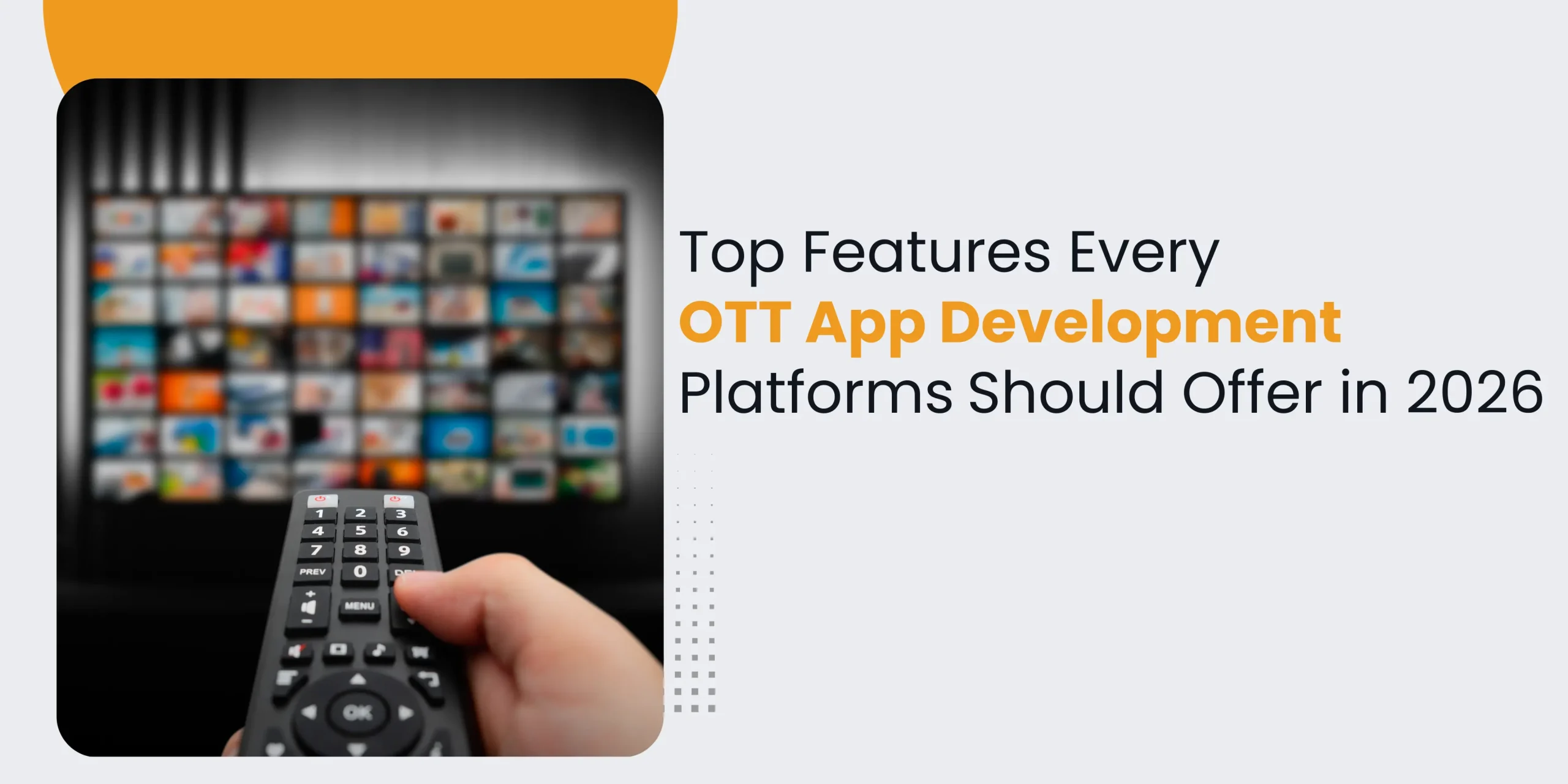
In 2026, the way we consume content has come a long way. On average, an American spends over an hour (70 minutes) each day on OTT platforms. On-demand streaming and OTT platforms have reshaped audience expectations and how we view content. Studies from as early as 2022 have reported that there were over 300 OTT application providers in the United States alone, with 88% of internet households holding at least one subscription. The number of OTT platforms since then has skyrocketed, with competition among them increasing steadily. This changes how we look at OTT app development in 2026. With increasing competition, the hundreds of OTT platforms that are now in the market are forced to fight for limited user attention. This leads to audiences being subjected to content overload, which makes discovery and retention more challenging than ever. It also becomes extremely important that new-age OTT platforms deliver a consistent experience across mobile devices, web, smart TVs, and streaming devices. User expectations have shifted toward more seamless, personalized, and uninterrupted experiences on OTT platforms.
OTT businesses can no longer rely on basic, run-of-the-mill video delivery platforms, and that is why choosing the right OTT app development platform matters now more than ever. A robust OTT app development platform must have a strategic role in scaling, monetizing, and retaining users. In this blog, we explore the top features that every OTT app development platform should offer in 2026 in order to stand out from the competition.
Core Capabilities of OTT App Development Platform
The competitive market demands OTT app development platforms to adapt to stay competitive. Before we jump into advanced features, let’s cover the foundational capabilities an OTT platform must support in 2026. These no longer act as differentiators but are basic requirements for operating in a highly competitive OTT ecosystem. Features like cloud-native scalable architecture, multi-device, and cross-platform support have become non-negotiable for OTT businesses in 2026.
- Multi-device & cross-platform support: As viewer behavior evolves, it is important that OTT platforms today support multi-device and cross-platform compatibility. Users expect a consistent experience and playback performance across their mobile (iOS/Android) devices, tablets, iPads, and smart TV devices.
- Scalable backend architecture: With user experience in prime focus, OTT apps should be able to handle traffic spikes during premieres and live events without performance degradation.
- Cloud-native infrastructure: Most OTT platform leaders like Netflix, HBO Max, Paramount+, etc., are built on cloud-native infrastructure for elasticity, ease of scaling, resilience, and cost efficiency. This supports rapid deployments, upgrades, and feature rollouts.
Now that we have established the non-negotiables, let’s explore the advanced features that every OTT app development platform should offer in 2026.
9 Top Features of OTT App Development Platform
2.1 Content Management & Delivery Features
Content is the central pillar for OTT platforms. Managing and delivering content efficiently is critical when it comes to running and scaling a successful OTT platform. Ensuring high-quality viewing should be a priority even while content libraries continue to expand.
- Advanced CMS: For a robust OTT platform, there should be a central content management system that allows teams to streamline the management of video content, thumbnails, subtitles, metadata, etc. This centralizes overall content workflows for ingestion, publishing, and updating content.
- Adaptive bitrate streaming and global CDN integration: Adaptive bitrate streaming ensures optimal quality across varying network conditions. Having a global Content Delivery Network (CDN) reduces latency and buffering by delivering content from the user’s nearest server. This enables fast and reliable content delivery.
- Live streaming and VOD support: OTT app development platforms should support both live streaming for launches, premieres, sports events, etc., and video-on-demand (VOD) for on-demand streaming.
- Content localization and multi-language support: With audiences growing beyond geographies, content localization becomes a necessity for OTT streaming platforms. Platforms must support multi-language audio, subtitles, and regional metadata to improve accessibility.
2.2 User Experience & Personalization
In an increasingly crowded and near-saturated market, user experience becomes a key differentiating factor. With the pool of users being limited, platforms should focus on delivering relevant, intuitive, and personalized experiences to retain users’ interest.
- AI-driven content recommendations: An intelligent recommendation engine can surface relevant content by analyzing viewing behavior. This curation creates a personalized experience that also improves content discovery and engagement.
- Custom home screens: Personalized watchlists and continue-watching features, when aligned with user interests and viewing history, enhance convenience, access, and session length.
- User profiles & parental controls: By supporting the creation of multiple user profiles under a single account, users can enjoy separate personalized viewing experiences. Parental controls provide younger audiences with access to age-appropriate content.
- Offline viewing with smart downloads: Smart downloads give users access to content without requiring internet connectivity. This provides users with flexibility and convenience.
2.3 Monetization & Revenue Management
A modern OTT app development platform should support multiple subscription and monetization models to appeal to multiple demographics, content types, and target audiences.
- Subscription (SVOD), Ads (AVOD), and hybrid models: Platforms should support flexible pricing models combining subscriptions and advertisements. Users can eliminate advertisements by opting for a subscription-based SVOD model or choose ad-supported streaming at a lower cost, with ads generating revenue for the platform. Hybrid customizable monetization models give businesses greater flexibility.
- In-app purchases and pay-per-view: Content can be segmented within the platform using transaction-based models, especially for premium content, live events, exclusive releases, and seasonal offerings.
- Ad insertion & targeted advertising: Advanced ad insertion and targeted advertisements based on user segments and behavior during live and on-demand content improve ad relevance and maximize revenue potential without compromising user experience.
- Flexible pricing and regional monetization: Regional pricing, promotions, trials, bundled offerings, and localized payment options help platforms expand into new markets effectively.
2.4 Analytics, Insights & Intelligence
In 2026, analytics have moved beyond basic reporting. They now require actionable intelligence to guide content, engagement, and business decisions. Analyzing the following metrics provides sufficient clarity to business owners.
- Real-time user engagement analytics: OTT platforms must provide complete transparency on how users interact with content across devices.
- Content performance tracking: Tracking content performance metrics like viewership, completion rates, and engagement helps teams evaluate content effectiveness. This also provides insight into audience behavior, which supports content optimization.
- Churn prediction & retention insights: By analyzing historical and behavioral data, platforms can predict churn rates—the rate at which users stop using or cancel a service. This enables targeted retention and promotional campaigns.
- Business intelligence dashboards: These dashboards give operational and executive teams a clear view of performance metrics and trends.
2.5 Security, Compliance & DRM
Ensuring content security, operational compliance, and enforcing digital rights management are critical factors for OTT app development platforms.
- Protection of premium and licensed content: It is extremely important that OTT app development platforms employ strong security controls to prevent piracy, unauthorized access, and revenue leakage.
- Secure authentication & role-based access control: Authentication strategies like token-based access, session management, and device validation restrict content access to authorized users only. Predefined permission levels for viewers, administrators, and content partners reduce operational and security risks and prevent piracy, illegal downloads, and screen recording.
- Digital watermarking: Digital watermarking embeds additional information into content without affecting quality, enabling tracing of illegally distributed content back to the source and deterring piracy.
- Regulatory compliance & geo-restrictions: OTT platforms should be developed in adherence to GDPR, CCPA, and regional privacy laws to protect user data and reduce legal exposure. Only content approved for specific regions should be displayed, in line with licensing agreements, legal guidelines, and local sensitivities.
- Content encryption & regular security audits: Content is often at risk of tampering and interception. To protect media assets, encryption at rest and during streaming should be implemented. Continuous vulnerability assessments help maintain platform integrity.
2.6 Integrations & Ecosystem Readiness
OTT platforms should not be treated as isolated monoliths. They should operate within a broader digital ecosystem to support growth, monetization, and flexibility.
- Payment gateway integrations: By integrating payment gateways, platforms can support subscriptions, PPV, and in-app purchases across regions.
- CRM integrations: Integrating with a central CRM enables customer lifecycle management, retention strategies, and targeted campaigns.
- Ad network integrations: These integrations are essential for AVOD and hybrid monetization models.
- Analytics and marketing tools: Analytics tools help assess performance metrics. Combined with marketing channels, they support user acquisition, engagement tracking, and performance optimization.
2.7 Scalability, Performance & Reliability
Even as content libraries expand, platform reliability and performance should remain optimal to deliver consistent viewer experiences at scale.
- Autoscaling & traffic management: The platform’s infrastructure should dynamically adjust resources for peak and off-peak usage. It must also support sudden surges during live events and premieres without compromising performance.
- Global CDN & low-latency, high-availability architecture: For live streaming and interactive content delivery, delays can significantly impact user experience. Delivering content from the nearest server minimizes latency, while a high-availability architecture reduces platform downtime.
- Reliability: Disaster recovery planning and failover mechanisms ensure continuity during outages or failure conditions.
- Load & stress testing: Validating platform stability under extreme conditions, combined with SLA-backed uptime guarantees, improves client trust and confidence.
2.8 Developer Experience & Time-to-Market
Developer efficiency directly impacts speed, innovation, and cost control, which are priority factors for businesses to stay ahead of competitors.
- Low-code/no-code configuration: Low-code or no-code capabilities allow rapid configuration, customization, and deployment without heavy engineering effort. This enables faster launches, especially in a highly competitive OTT market.
- CI/CD support: This enables faster rollouts of updates, automated testing, and bug fixes.
- Rapid experimentation: The platform should support rapid A/B testing and iterative improvements.
2.9 AI & Automation Capabilities (2026 Differentiator)
AI integration and automation are the number one differentiating features OTT app development platforms are embracing in 2026. They help platforms manage scale, improve personalization, and reduce operational overhead.
- Content management: AI simplifies content management and organization as libraries grow. Artificial intelligence can automate content tagging and metadata enrichment, improving searchability and discoverability. It can also classify content automatically by genre, mood, and theme.
- User segmentation & personalization: AI analyzes user viewing behavior to enable intelligent user segmentation and personalized content recommendations at scale.
- Predictive analytics and forecasting: Based on user behavior, AI anticipates churn, engagement trends, and content performance. It can also analyze viewing trends to forecast revenue and recommend monetization models.
- Real-time quality analysis: AI automates QA to assess stream quality, buffering, and playback issues. It can also monitor streams and flag anomalies in real time.
Choosing the Best OTT App Development Platform Built for 2026
The OTT market is changing drastically and rapidly. With the market nearing saturation, it is pivotal to choose the right OTT app development platform to gain a sustainable competitive advantage. We have discussed the top features that an OTT app development platform should offer. User experience, scalability, intelligence, security, and flexibility are all critical aspects to account for when considering an OTT app development partner. Beyond feature checklists, platforms must be evaluated on how well they adapt to evolving user expectations and business models.
The right platform should not only support today’s requirements but also scale seamlessly with future growth. Ultimately, choosing a future-ready OTT platform is a strategic decision that directly impacts long-term success.
Ready to turn your idea into a powerful digital solution?
Partner with our experts to design, build, and scale technology tailored to your business goals.
Contact us Today