Artificial intelligence has successfully integrated itself with our daily practices in the last few years. But beyond just improving productivity and managing daily tasks, enterprises are embracing AI to innovate their products and to elevate their service delivery capabilities. From understanding customer pain points to accurately predicting and proactively adapting to industry trends and market requirements, AI can enhance business operations significantly. AI integration in workflows and service pipelines can deliver profitability for businesses of any scale. Embedding AI into the product development lifecycle can provide businesses with a competitive edge, especially in cutthroat markets. Businesses from across industries have always been in active pursuit of finding ways to make the best use of the latest technology innovations. Artificial intelligence is no different. In order to stay competitive in an increasingly competitive environment while staying compliant with industry-specific standards and regulations, businesses are integrating ethical AI practices into their product, services, and internal workflows.
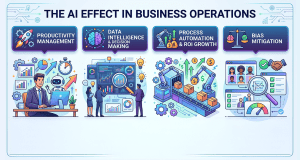
The AI Effect in Business Operations
Productivity Management
Artificial intelligence is fundamentally reshaping business operations by introducing speed, intelligence, and automation into everyday workflows. One of the primary drivers behind AI adoption is productivity improvement. AI acts as an additional workforce across departments, reducing the burden on employees and enabling teams to focus on higher-value, strategic tasks. Routine activities such as data entry, document processing, scheduling, and reporting can now be automated with high precision, significantly reducing manual effort. With the rise of advanced AI tools and domain-specific language models, task execution accuracy is estimated to range between 88% and 98%, minimizing human error and improving consistency.
Data Intelligence & Decision making
AI is also transforming how organisations make decisions. As enterprises grow, so does the volume of data they generate. AI systems can ingest and analyse data from multiple, disparate sources to identify patterns, forecast trends, and simulate potential outcomes. This allows businesses to shift from reactive decision-making to proactive and predictive strategies. Whether it is demand forecasting, financial planning, or risk management, AI enables faster and more informed decisions backed by real-time insights.
Process Automation & ROI Growth
Another major impact of AI is its contribution to operational efficiency and cost optimisation. A 2025 study by Capegemini notes that organisations are improving their average ROI by up to 1.7 times through AI investments. Deloitte’s 2025 report on AI ROI states that for agentic AI, half (50%) of organisations expect returns within one to three years, with another third (33%) anticipating three to five years. Across key functions such as finance, procurement, human resources, and customer service, companies report cost savings of 26% to 31% due to automation and process optimisation. These efficiencies allow businesses to scale operations without a proportional increase in costs or workforce.
Bias Mitigation
AI also introduces a level of objectivity that is difficult to achieve with purely human-driven processes. Unlike humans, AI systems, when trained on high-quality datasets, can operate with reduced bias and deliver consistent outputs. This enhances the reliability of decision-making and reduces variability across operations.
Finally, AI is driving a shift toward intelligent and adaptive business models. Organisations are moving beyond basic automation to build systems that continuously learn, optimise, and improve over time. As AI adoption becomes more widespread, it is no longer just a tool for efficiency but a core component of modern business strategy, enabling organisations to operate faster, smarter, and at scale while unlocking new opportunities for growth.
Artificial Intelligence Use Cases Across Industries
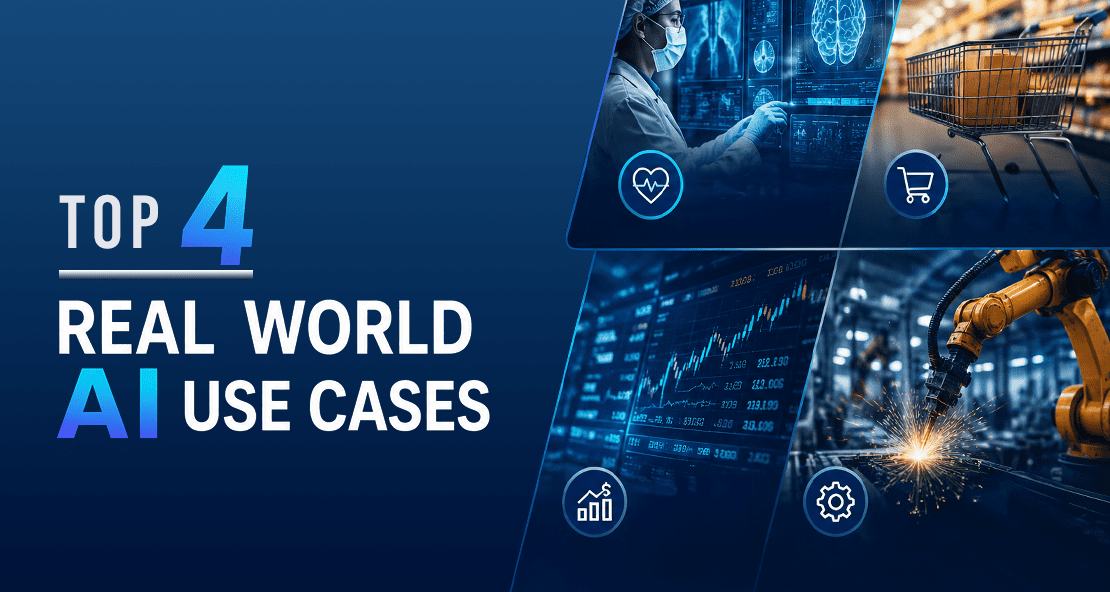
Now that we’ve discussed how AI integration can drive profit, productivity, and business opportunities. Let’s explore some industrial AI use cases and how they can elevate products, services, and internal operations across industries.
AI Use Cases in Healthcare & Life Sciences
Healthcare & life sciences is an industry where AI integration and innovation are making huge strides. From diagnostics and personalised care to research & development of drugs, AI can elevate the overall quality and speed of service delivery significantly.
AI models, when integrated with HAS systems, can analyse patient data and treatment history in detail to help generate faster insights and intuitively recommend treatment plans. It can tailor care plans aligned with the genetic makeup and history of patients for better treatment outcomes. This integration can help in forecasting potential disease outbreaks, epidemics, and patient deterioration using EHR patterns. It can also predict post-treatment risks and survival probabilities. When integrated with EHR, AI chatbots can provide customised medication recommendations, dietary information, appointment scheduling services, etc., based on patient ID.

Medical imaging is another segment that is currently progressing from AI experimentation to execution phases, driving substantial improvements. Sully AI did a 2026 study, which showed that the test interpretation and diagnostic accuracy of AI engines have significantly improved, with their report claiming 90-95% accuracy in MRI/X-ray image processing. This also alleviates workload for radiologists by 40-70% by automating anomaly detection in scans. AI can help optimise dose maps in radiology so that it does not affect healthy cells much while targeting tumours. Before symptoms even begin to surface, AI can leverage its image processing capabilities to predict and flag risk factors which could help detect cancer and heart diseases early on. It can identify clots by analysing CT scans, detect pulmonary embolisms, mark out malignant and benign tumours, screen X-rays for tuberculosis, etc. and coordinate urgent responses. This proactive approach could significantly improve survival chances and treatment efficacy among patients.
In pharmaceuticals, for drug discovery and candidate screening in clinical trials, AI can help by simulating molecular interactions to identify viable compounds and match patients to trials. It can also simulate trial cohorts for diverse representation during the patient population of the R&D process. Apart from this, AI can pinpoint proteins or genes via genomics/proteomics for selective therapies and find disease indicators or biomarkers for early detection. It can generate novel compounds with desired properties and optimise targets for gene edits while minimising off-target effects.
In surgical procedures, surgical robotics can improve precision in minimally invasive procedures. AI-integrated applications can analyse speech patterns and movements to detect early signs of neurological conditions such as Alzheimer’s and Parkinsons. For senior citizens and high-risk patients, wearable device data is analysed for continuous monitoring. AI can autonomously alert emergency services if real-time values are outside pre-set thresholds. This approach extends care even outside hospital premises.
AI in Manufacturing & Supply Chain
Artificial Intelligence is transforming manufacturing and supply chain operations through predictive analytics, automation, and intelligent optimisation, enabling greater efficiency, resilience, and scalability.
In manufacturing environments, AI continuously monitors industrial equipment using sensor data to predict potential failures and reduce unplanned downtime. McKinsey & Co. reports up to 40% machine life extension and 50% cut in downtime. AI optimises production processes by analysing operational data to fine-tune workflows, with McKinsey’s Lighthouses report (2024) detailing AI achieving 10-25% energy reductions and up to 70% waste cuts in factories like Mondelēz and CITIC steel. AI-powered digital twins further enhance efficiency by creating virtual replicas of factory environments using real-time IoT data and machine learning models. These simulations allow organisations to predict outcomes, test scenarios, and enable autonomous adjustments such as rerouting production flows. It has been noted that this results in improvements in throughput without physical risks or downtime. Computer vision achieves 96% accuracy in real-time defect detection per recent edge AI manufacturing research.
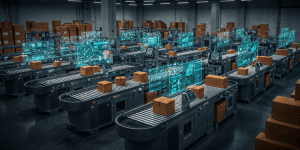
Within warehouse and inventory management, AI enhances operational efficiency through automation and optimisation. It enables automated inventory management by continuously monitoring stock levels and triggering replenishment, reducing errors and improving speed. AI also optimises warehouse layout and space utilisation by analysing product demand and inventory patterns. This involves strategically organising storage areas to maximise capacity and reduce order fulfilment time. Advanced algorithms streamline order picking and processing, improving workforce utilisation and minimising bottlenecks.
AI also strengthens demand forecasting and supply planning by analysing large volumes of historical and real-time data. This allows businesses to dynamically adjust inventory levels, calculate safety stock, and prevent both stockouts and overstocking. Additionally, AI helps mitigate the bullwhip effect by synchronising demand and supply signals across the supply chain, reducing fluctuations and improving overall stability. Supplier performance can also be evaluated by analysing historic data, enabling organisations to identify reliable vendors and negotiate better terms.
In logistics, AI enables end-to-end optimisation of transportation and delivery. Route optimisation algorithms analyse traffic, weather, and vehicle capacity to determine the most efficient paths, reducing fuel consumption and transit time. AI also supports real-time shipment tracking and monitoring through IoT integration, providing visibility across the supply chain and issuing alerts for delays or disruptions. Predictive ML models analyse historical shipping data, port congestion, and carrier performance to forecast delays. They also enable proactive actions such as rerouting shipments or selecting alternative carriers from this data. These capabilities significantly improve delivery reliability and customer satisfaction.
AI further enhances operational intelligence through risk management and anomaly detection. By analysing globally available public domain data sources, AI can identify potential disruptions such as geopolitical risks, demand shocks, or supply shortages, enabling proactive mitigation strategies. It also detects irregularities in shipments, transactions, or orders, reducing fraud and operational errors. Reverse logistics is also optimised, with AI analysing returns and repair data to improve inventory allocation and reduce costs.
Workforce and resource management are also significantly improved through AI. By analysing workload data, order volumes, and processing times, AI dynamically allocates tasks based on employee skills and availability, reducing inefficiencies and improving productivity. It also forecasts seasonal demand fluctuations, enabling better workforce planning. Additionally, generative AI copilots assist employees with process-related queries, accelerating onboarding and improving decision-making speed.
AI also contributes to sustainability and strategic optimisation. It enables tracking of carbon footprints across operations and supports dynamic pricing strategies by forecasting demand and logistics costs in real time. AI-driven yield analysis further identifies inefficiencies in production, helping organisations improve output quality and reduce waste.
Overall, AI transforms manufacturing and supply chain operations into intelligent, adaptive systems that are data-driven, efficient, and resilient, enabling organisations to scale effectively while maintaining operational excellence.
AI in Education and Technology
In education and learning domains, AI can deliver curated, personalised learning experiences based on individual learner data, including behavioural patterns, learning styles, syllabi, etc.
Intelligent tutoring systems, or ITS, can provide students with adaptive instructional guidance and coaching based on their learning pace using ML algorithms in natural language. AI can formulate personalised learning paths by customising the curriculum by analysing student behaviour, gaps in learning, and personal preferences. It can autonomously generate assessment tools like quizzes and tests while dynamically analysing student performance to adjust difficulty levels. AI agents could grade essays, tests, and assignments at scale via NLP and OCR. It can review grammar, structure, and plagiarism, and intuitively check for content alignment automatically to grade essays. Using an agentic AI system coupled with an ML model, at-risk learners could be identified early on for proactive intervention to improve their performance.

Student engagement could be significantly improved with AI chatbots that could provide 24/7 query resolution, deadline reminders for course completion, and general admin guidance. Students could be rewarded with badges and/or points to boost overall motivation. AI can also act as a learning buddy for kids with learning disabilities and special needs. They could also benefit from interactive AI, helping them improve their social skills.
Another AI use case in EduTech is that AI-powered learning management platforms can alleviate the workload from teachers and tutors by helping them keep track of student performance and progress. This enables them to identify students who are falling behind so as to provide them with the required support on time. Such AI-integrated platforms could help teachers in automating curriculum setting, progress tracking, gap identification, test preparation, and assessment & grading. This effectively lets tutors streamline their efforts in providing the proper coaching and guidance for students and preventing burnout.
Studies show that interactive learning helps students retain information for longer while supporting active recall of study material. AI can produce interactive flashcards based on syllabus and program curriculum to dynamically test progress and analyse gaps in learning. By providing AI-powered AR/VR interactive simulations of the syllabus, students can fully experience immersive environments of historical events, human anatomy, etc.
Parents can also be more involved in the students’ courses through AI-integrated educational platforms. The platform notifies them in case of absence, helps them track their attendance and course progress, and provides insights on grades along with detailed suggestions on how to improve performance. Overall, AI in the education space enhances the learning capabilities of students while relieving parents and teachers of extra workload.
AI in Media, Sports, and Entertainment
With AI entering the media space, content creation has become a democratized ecosystem for individuals, regardless of their experience or background. AI can automate script creation, video editing, and captions/subtitles addition. It can autonomously analyse long-form video footage to create highlight reels and summaries, cutting production time by over 70%. Generative AI engines can take any text prompt provided by the user and turn it into stunning visuals and graphics, which would otherwise require a full production team of experienced creatives. AI can also create deepfakes or ultra-realistic CGI renditions of characters and scene extensions for films.

With OTT applications at the peak of competition, integrating AI can provide a competitive edge by focusing on user experience and personalisation. Recommendation engines analyse user behaviour to provide relevant and hyper-personalised recommendations of shows, music, movies, and more, thereby improving user retention and content discoverability. Each user enjoys a personalised feed that is carefully curated to match their content preferences. To further enhance the streaming experience, users are served targeted advertisements that are context-aware. AI engines can also intelligently identify product placement opportunities during gaming events, further enhancing the viewing experience. This is also ideal for sponsors, as their products are viewed by their target audience.
In sports, AI has found its footing in analysing player performance statistics, weather data, and other relevant historical data to predict future outcomes with high accuracy. By leveraging computer vision, player positions and ball trajectories can be tracked to detect fouls or offside calls. In AI-powered fantasy leagues, fans can place bets on their favourite players, which are evaluated using unbiased preset player performance models. This enhances fan engagement by turning passive viewers into active participants who manage virtual teams. By leveraging NLP/ML to process live interactions of fans on social media and other public channels, to establish the nature of reactions to trigger broadcast adjustments like hype segments or player close-ups during peak excitement.
While exploring AI use cases in media, sports, and gaming industries, immersive viewing experiences powered by AR/VR and their further enhancements with Artificial Intelligence should also be considered. Using computer vision, the viewer’s eye movements/head position could be tracked to adjust the positions of the AR overlays (player stats, instant replays, etc.) in real-time. AI can also upscale graphics for photorealistic AR/VR experiences, making it look more real.
In the gaming industry, Generative Adversarial Networks (GANs) are used to generate infinite game worlds and levels dynamically in real-time. These levels are adapted to player behaviour for a personalised gaming experience without requiring manual design. AI can also adapt the game’s difficulty level based on players’ skill levels in real-time.
Want to know how you could use AI for your industry?
How to Integrate AI for Lasting Business Success?
To ensure the successful implementation of AI in business operations, the following parameters should be strictly considered:
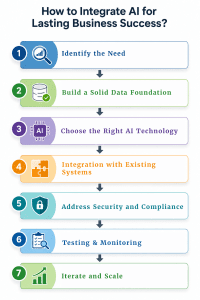
1. Identify the Need
As a first step of AI integration, it is important to assess the problem areas and customer pain points that could be eliminated with AI addition. This could include any bottlenecks in internal process workflows, issues in the service delivery pipelines, or product feedback. Once the need is established, set clear measurable targets for efficiency gains, cost savings, or customer experience improvement. This would help in tracking the efficiency of AI integration while preventing scope creep.
2. Build a Solid Data Foundation
With an AI system, the output quality strongly relies on the quality of the input data on which it was trained. The accuracy, completeness and relevance of the current data set should be analysed in detail. This data set should then be cleaned, gaps should be eliminated, and updated with the latest data. This would eliminate any incorrectness and bias from the output that the AI system provides.
3. Choose the Right AI Technology
Depending on the requirement or expectation from the integration, computer vision, machine learning (ML), predictive modeling or natural language processing (NLP) should be selected. For example, if the business requirement is query resolution for their clients with accurate company information, then an AI/NLP chatbot trained on company-related data should be the choice.
4. Integration with Existing Systems
The proposed AI solution should seamlessly integrate with the existing systems and workflows. The integration should be tested for interoperability to maintain operational continuity without downtime during rollout.
5. Address Security and Compliance
AI models often deal with sensitive data, which poses significant risks related to data privacy, model bias, security vulnerabilities, and unintended consequences. Ensuring compliance with standards and regional regulatory requirements is of utmost importance.
6. Testing & Monitoring
Testing interoperability and accuracy would ensure the smooth execution of the system under real-life scenarios. The model ideally should be able to generalize effectively and perform well on new data. Multiple scenarios should be simulated to avoid biases and errors that might lead to issues, such as discrimination.
7. Iterate and Scale
Retraining models and incorporating a feedback loop will improve accuracy and sustained performance. Business priorities should be the focus while scaling operations so as to avoid scope creep and efficiency drains.
Travancore Analytics: The AI Experts
The ideal AI ML development company must be able to identify the industry’s unique pain points and operational bottlenecks to elevate service delivery capabilities. Travancore Analytics has been at the forefront of AI-driven excellence with over 18 years of software innovation experience and an impressive clientele from around the globe. With major clients spanning from industry leaders to startups with unique value propositions, we have been there for our clients’ AI innovation journey since day 1. Our clients across major industry areas like manufacturing, healthcare, media, etc., have seen huge improvements by adopting AI in their internal workflows and service delivery pipelines.
We streamline their AI journey through strategic consulting and identifying AI use cases relevant to their industries to craft custom AI solutions tailored to enhance their operations, services, and products. Our expertise spans Gen AI applications, AI chatbots, Agentic AI frameworks, RAG, etc., to elevate your business operations.
Future-ready with AI
Leading enterprises from around the globe are adopting AI innovation to elevate their workflow and service capabilities. Artificial intelligence has the unique possibility of being integrated with any vertical without disrupting operations. With core industries like manufacturing and healthcare displaying high productivity gains, high ROI, and user experience improvements, any business that is not integrating AI at this time is more or less leaving money on the table.
Looking to enhance your service offerings with AI innovation?
Connect with our AI experts today
Ready to turn your idea into a powerful digital solution?
Partner with our experts to design, build, and scale technology tailored to your business goals.
Contact us Today