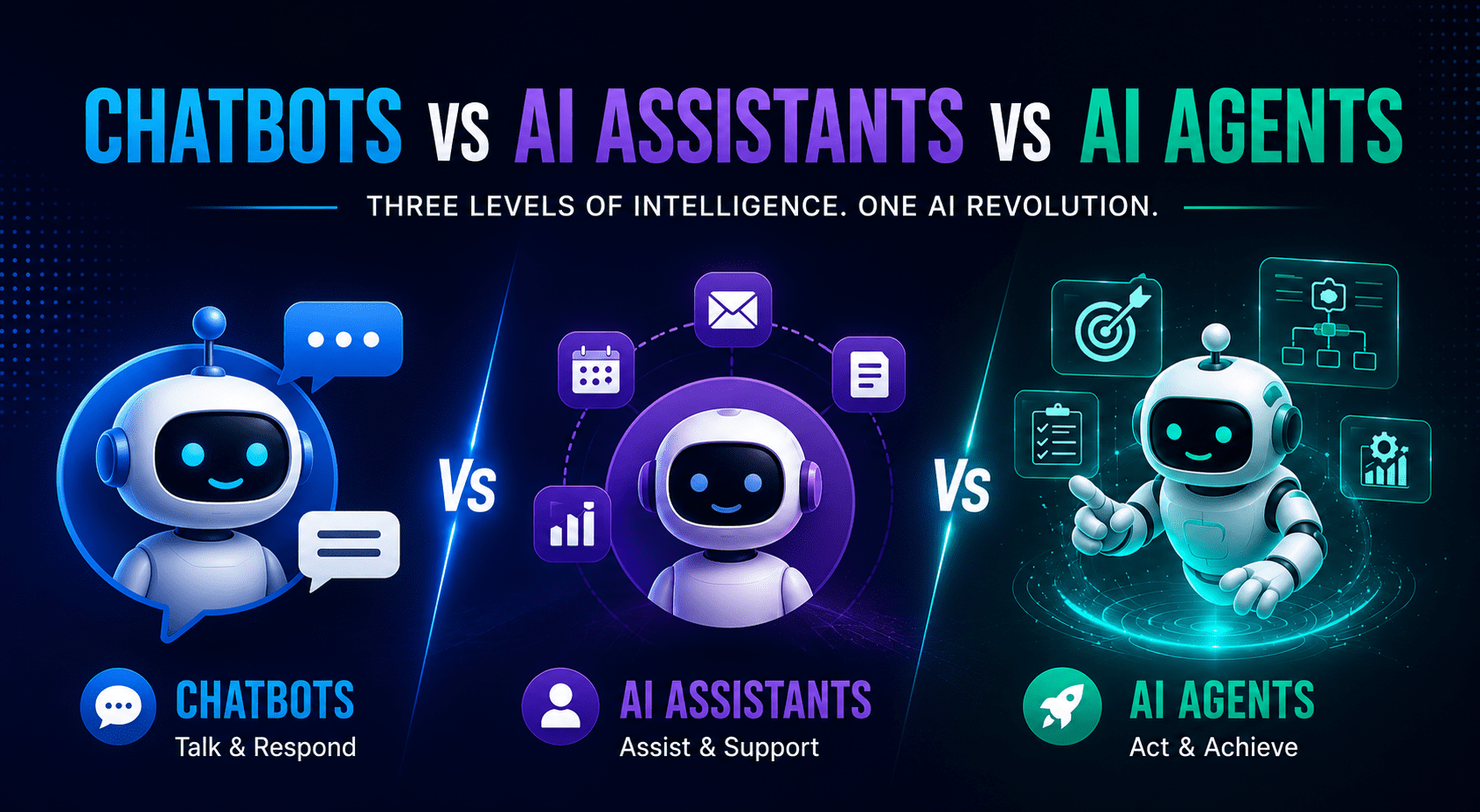
Conversational AI chatbots, AI assistants, and AI agents are often used interchangeably as if they were synonymous, but they are different in terms of intelligence, autonomy, and functionality. With AI technology now factored into regular business use, this distinction is more significant than ever. From responding to a simple question to orchestrating a process from beginning to end, these technologies are making their mark while offering companies the possibility of a more intimate customer relationship.
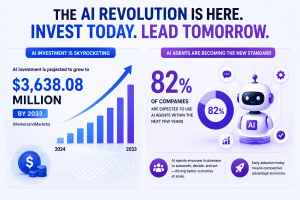
By 2033, AI investment is projected to grow to $3,638.08 million (MarketsandMarkets), and 82% of companies are expected to use AI agents within the next few years, making it all the more important to select the right tool—and not just wait for it to be an option. To make a more informed decision, the first thing you should be able to do is to understand what really makes these technologies different.
What are Conversational AI Chatbots?
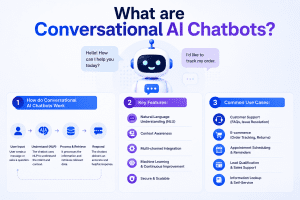
Conversational AI chatbots are highly intelligent applications that can understand, analyze, and communicate with human users naturally and interestingly. AI chatbots can understand and respond to user queries in a much more human and intelligent way, using sophisticated techniques such as NLP, ML, and LLMs, which are totally distinct from the preprogrammed responses provided by traditional chatbots.
How do Conversational AI Chatbots Work
When a user asks a question, the chatbot:
- The chatbot receives and interprets a user’s query.
- It identifies intent and picks up on relevant context.
- It pulls information from connected knowledge bases or business systems.
- It crafts and delivers a natural, relevant response.
The outcome? Interactions that feel more like a conversation with someone who understands you and less like a form.
Key Features:
- Understand and respond to natural language queries in real time.
- Provide 24/7 automated customer support and self-service assistance.
- Deliver consistent experiences across websites, apps, and messaging platforms.
- Leverage context and knowledge bases to offer relevant, personalized responses.
Common Use Cases:
- Real-time customer support and FAQ automation
- Multi-channel engagement across websites, apps, and messaging platforms
- Self-service assistance for industries like banking, healthcare, and e-commerce
- Appointment scheduling and lead generation
Gone are the days of waiting in long customer service queues for hours; with AI-powered chatbots, users can now receive instant responses from a virtual agent around the clock. Customer satisfaction is a major advantage of conversational AI chatbots, as they can respond to customers’ inquiries faster, retaining the support staff’s efficiency and reducing the work hours required to handle loads. But there are limitations to them. While many chatbots are capable of conversation, they often cannot perform sophisticated tasks on their own, and will not be able to perform tasks in more complex scenarios that require advanced reasoning and decision-making.
What Are AI Assistants?
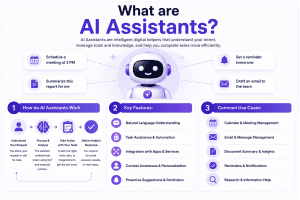
AI assistants are smart programs that let users communicate with them in natural language, thereby automating tasks, getting information, and boosting efficiency. Unlike more rigidly programmed chatbots that can only answer certain questions, AI-powered virtual assistants will be able to maintain context and take note of users’ preferences, offering more personalized support as it interacts with users multiple times over time. The Salesforce 2025 survey results revealed that 96% of workers are optimistic that AI agents and assistants will improve the work experience in the next five years or longer.
How Do AI Assistants Work?
AI assistants combine Natural Language Processing (NLP), machine learning, and generative AI to interpret requests and provide relevant assistance. They can:
- Understand user preferences and past interactions
- Maintain contextual awareness throughout conversations
- Integrate with business applications, calendars, databases, and collaboration tools
- Generate content, recommendations, and actionable insights
Key Features:
- Personalized recommendations and task management
- Information retrieval and knowledge management
- Workflow assistance and cross-platform support
Common Use Cases:
- Virtual workplace assistants and IT support
- Productivity enhancement and meeting scheduling
- Decision support across business functions
The more users interact with AI assistants, the better they get, especially because they remember preferences over time, adapting their responses and recommendations to each user’s individual needs — a trait that sets them apart from standard chatbots that provide generic information and suggestions. Despite that, they still have their boundaries: They require user commands to operate; they still have some privacy concerns with sensitive information; and they are not fully autonomous to carry out complex multi-step tasks
What Are AI Agents?
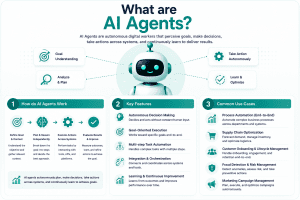
AI agents are intelligent programs that can sense, think, decide, and act with minimal human involvement. Unlike AI assistants, which usually need to be instructed by the user and rely on the user’s guidance, AI agents might be capable of creating and implementing multi-step jobs to accomplish a specific objective without any human intervention. According to Precedence Research, 96% of organizations plan to scale up their use of agentic AI, and the adoption rate of such a technology is expanding at a CAGR of 43.84% and is expected to hit $199 billion by 2034 with 79% of organizations using it to some degree as of 2025. It is evident that, AI agents are no longer experimental, it’s now part and parcel of the operational infrastructure.
How AI Agents Work
AI agents combine advanced AI capabilities with business systems and external tools to:
- Perceiving inputs from their environment (data, tools, user context)
- Reasoning through a goal and breaking it into actionable steps
- Executing tasks by interfacing with external tools, APIs, and systems
- Iterating and self-correcting based on outcomes — without being prompted each time
Key Features:
- Goal-driven autonomy and multi-step task execution
- Tool use and real-world system integration
- Memory and adaptive learning across interactions
- Multi-agent collaboration for complex workflows
Common Use Cases:
- Automated software development and code review
- End-to-end customer service resolution
- Supply chain monitoring and operational decision-making
- Research synthesis, report generation, and financial analysis
The implementation of AI agents can greatly ease processes, reduce manual work, and perform complex tasks for large volumes of data. But they also faced challenges related to regulatory issues, security concerns, and reliability in complex environments, as well as the need for human intervention in decision-making processes vital to the application. This leads to the need to strike a balance between autonomy and proper accountability and control measures in successful adoption.
Conversational AI Chatbots vs AI Assistants vs AI Agents: Key Differences
Feature |
Conversational AI Chatbots |
AI Assistants |
AI Agents |
| Primary Purpose |
Answer queries and automate conversations |
Assist users with tasks and information | Achieve goals through autonomous actions |
| Level of Intelligence |
Conversational and reactive |
Context-aware and assistive |
Autonomous and decision-driven |
| Context Retention |
Limited to the conversation context |
Maintains user preferences and history |
Continuously learns and adapts to context |
| Personalization |
Basic to moderate |
High |
Very high |
| Task Execution |
Handles simple, predefined tasks |
Performs user-directed tasks |
Executes complex, multi-step workflows independently |
| Decision-Making Ability |
Minimal |
Guided by user input |
Autonomous and goal-oriented |
| Proactivity |
Primarily reactive |
Can provide suggestions and reminders |
Takes proactive actions to achieve objectives |
|
System Integration |
Connects with knowledge bases and support tools | Integrates with productivity and business applications |
Integrates with multiple tools, systems, and workflows |
How Can Businesses Choose the Right AI Solution?
Chatbots have their scripts, assistants have their triggers, and agents have their goals. In any discussion concerning which one to use, there is no right or wrong answer because it all depends on matching the capability to the need. Think about what your customers need: speedy scripted replies or personal chat interactions? Are the tasks getting difficult, or would you prefer an automated system that runs on its own without you having to assist it? Think about what your budget is, the resources at hand, and the level of independence you would like for your solution.
The Future of Intelligent AI Systems: What Comes Next!
The distinction between chatbots, assistants, and agents is becoming increasingly indistinct – today’s tools are increasingly stealing functionality from each other, making it easier to feel like you’re talking to a human while being acted upon by a machine. You don’t have to go with one type or stay in one type forever; the future is about growing and changing as you need to. The right tool could be a chatbot, an assistant, or an agent – or all three. The real question is what the best solution is to meet today’s needs and allow for future growth into tomorrow’s solutions. Not yet sure which to choose – chatbot, assistant, or agent? Collaborate with Travancore Analytics to create the perfect AI solution – customizable, scalable, and results-driven.
Ready to turn your idea into a powerful digital solution?
Partner with our experts to design, build, and scale technology tailored to your business goals.
Contact us Today