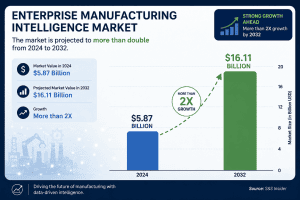
Walk into any modern factory floor today, and what you see isn’t just machinery humming in sync—it’s data flowing in real time, quietly making smarter decisions than any shift supervisor ever could alone. Manufacturing has always been a game of margins, but the rules are changing fast. The Enterprise Manufacturing Intelligence market, valued at $5.87 billion in 2024, is projected to more than double to $16.11 billion by 2032 (S&S Insider) — a clear signal that manufacturers aren’t just experimenting with data intelligence anymore; they’re betting their entire operational future on it. This is the story of how they’re winning.
What is Data Intelligence in Manufacturing?
Manufacturers generate vast amounts of data every day, from IoT sensors and production equipment to ERP systems, supply chain platforms, and quality control processes. Data intelligence isn’t just about collecting numbers from machines; it’s the disciplined process of connecting, contextualizing, and acting on data from every corner of the operation to make smarter, faster, real-world decisions. Manufacturers can leverage this data to gain insights into trends, identify inefficiencies, anticipate problems, and make real-time optimizations across systems. Leading manufacturers take data intelligence to provide business value, not just operational visibility.
Analytics can boost EBITDA margins by up to 10% and cut machine downtime by up to 50%.
How Do Manufacturers Use Data Intelligence to Improve Operational Efficiency?
1. Predictive Maintenance: Preventing Downtime Before It Happens
Consider the price of a critical machine that stops working during a production run. A single idled production line in the auto industry can cost up to $2.3 million per hour, and the world’s 500 largest companies lose approximately $1.4 trillion due to unplanned outages every year, according to Siemens’ True Cost of Downtime 2024 report. Data Intelligence reverses this very equation. The IoT sensors can continuously monitor machine health, alerting manufacturers to even the smallest changes in temperature, vibration, and pressure before they become a full-blown breakdown. Algorithms that are exposed to data on historical performance identify patterns that can predict failure days (in some cases, weeks) ahead of time.
Maintenance teams shift from reactive firefighting to proactive scheduling, servicing equipment during planned windows rather than emergency shutdowns. Loss of shifts due to surprise failures is no longer a possibility at a factory that now gets early warning and pre-positions repair crews. The machine continues to operate, and the line continues to proceed forward.
2. Real-Time Production Monitoring
Over the years, manufacturers operated their floors based on feedback that was delayed – reports of what had gone wrong rather than what was going wrong at that moment. Real-time production monitoring changes all that. Rather than finding a bottleneck hours after it hinders output, managers can spot it as it happens and take steps to prevent it from becoming a reported issue. Live views of machines, sensors, and production systems are captured in an integrated dashboard, allowing manufacturers to see production second by second, including throughput, cycle times, and equipment utilization data. Any constraints that were gradually reducing production would be immediately apparent. Managers can redirect resources, modify work timelines, or stop a buggy process before it snowballs. As production information becomes real-time, there are no more blind spots and thus no more expensive guesswork in factories.
3. Improving Product Quality Through Data Insights
When a defect makes it all the way to the customer, it also ends up costing trust. As many as 73 percent of manufacturers have experienced a product recall in the past five years, and one recall can cost as much as $100 million (360marketupdates). That’s the real price of quality blind spots. Data intelligence illuminates those blinds. Production is monitored in real time by sensors and AI-based inspection systems, which alert to deviations as soon as they occur and not after defective products are put into packaging and sent off. Where anomalies do occur, root cause analysis tools can be used to identify the cause of the anomaly, whether it is from a miscalibrated machine, a material anomaly, or a process problem that has arisen as a result of shifting values.
Issues are addressed, and the continuous improvement loops are in place, further strengthening the quality standards. Reduced waste, lower rework costs, and higher customer satisfaction aren’t side effects of better-quality management. They are its natural output.
4. Optimizing Inventory and Supply Chain Operations
Excessive inventory is a capital tie-up. Too little inventory results in over-priced stock-outs and lost orders. As a manufacturer, finding that “balance” has always been more of an art than a science. Data intelligence translates it into a science. Predictive analytics can use demand signals, order histories, and market trends to be much more accurate about what is required and when, compared to traditional forecasting methods, which rely on guesswork and intuition. Another layer added by supplier performance monitoring: risks come to light earlier rather than later, when they are a problem on a delivery. End-to-end supply chain visibility is the ability to avoid unexpected surprises, streamline fulfillment, and have inventory levels aligned with the real world rather than assumptions. If the supply chain runs on data, it ceases to be the weakest link and becomes a competitive advantage.
5. Enhancing Resource Utilization and Production Planning
A system that can be used efficiently in manufacturing maximizes the use of people, equipment, materials, and energy. Data intelligence can help manufacturers identify their production strategies, resource availability, and performance indicators, and then use these insights to make more informed planning and allocation decisions. If an organization knows where resources are being used, then it can optimize its production time, reduce idle time, improve the productivity of its workforce, and reduce energy consumption.
These insights aid in establishing the balance and efficiency of the operation, as well as business growth. This allows for more efficient use of resources, operating them in real-time and providing significant efficiency and performance benefits for the manufacturing industry.
Turn Manufacturing Data into Actionable Intelligence
Looking to unlock the full potential of your manufacturing data?
DataLens, our AI-powered data intelligence platform, helps manufacturers unify data from multiple sources, uncover operational insights through natural language queries, monitor KPIs with interactive dashboards, and make faster, data-driven decisions—all without complex analytics workflows.
Explore DataLens
Key Technologies Powering Manufacturing Data Intelligence
Data intelligence in manufacturing is not just one technology; it’s a stack—and each layer counts:
IoT Sensors — These are in place on the shop floor and gather continuous streams of real-time operational data.
Cloud platforms — Store, consolidate, and make that data available across systems and locations in real time.
AI & Machine Learning — Identify patterns, forecast failures, and enhance recommendations for each cycle of production
Advanced Analytics — Turn complicated data outputs into actions that humans can take in real-time.
Digital Twins — Virtual copies of assets and production lines that allow manufacturers to run simulations and test scenarios without stopping any machines.
Combined, these technologies empower manufacturers to step beyond data collection and use information to create actionable data that creates operational efficiencies.
The Future of Data Intelligence in Manufacturing
Future manufacturing is for businesses that can convert data into action and incremental change. Manufacturers will transition from data analysis to making quicker, more informed operational decisions as AI-influenced decision-making evolves into a more sophisticated process. The future of Industry 4.0 will focus more on intelligence, adaptability, and responsiveness on the fly.
Predictive operations will enable businesses to foresee problems and deal with them before they arise, and autonomous systems will simplify and optimise complex business processes. In the face of the rapid changes in the industry, manufacturers who adopt data intelligence today are setting the stage for future agility, innovation, and competitiveness.
Final Thoughts
Data intelligence is changing the way manufacturers are doing business, moving from reactive to proactively driven and insightful decision-making. From preventing a machine failure before it occurs and optimizing quality on the line, to optimizing a supply chain and deploying the right resources at the right time, the thread that ties all of these improvements together is the same one: Better decisions driven by better data. With operational complexity on the rise, manufacturers that view data as a strategic asset, not just an operational byproduct, will have a greater ability to be efficient, resilient, and competitive in a market space that can’t afford guesswork.
Looking to get the most out of manufacturing data?
Collaborate with Travancore Analytics and use cutting-edge technologies to streamline operations, enhance efficiency, and gain a competitive edge in the ever-changing business landscape.
Ready to turn your idea into a powerful digital solution?
Partner with our experts to design, build, and scale technology tailored to your business goals.
Contact us Today