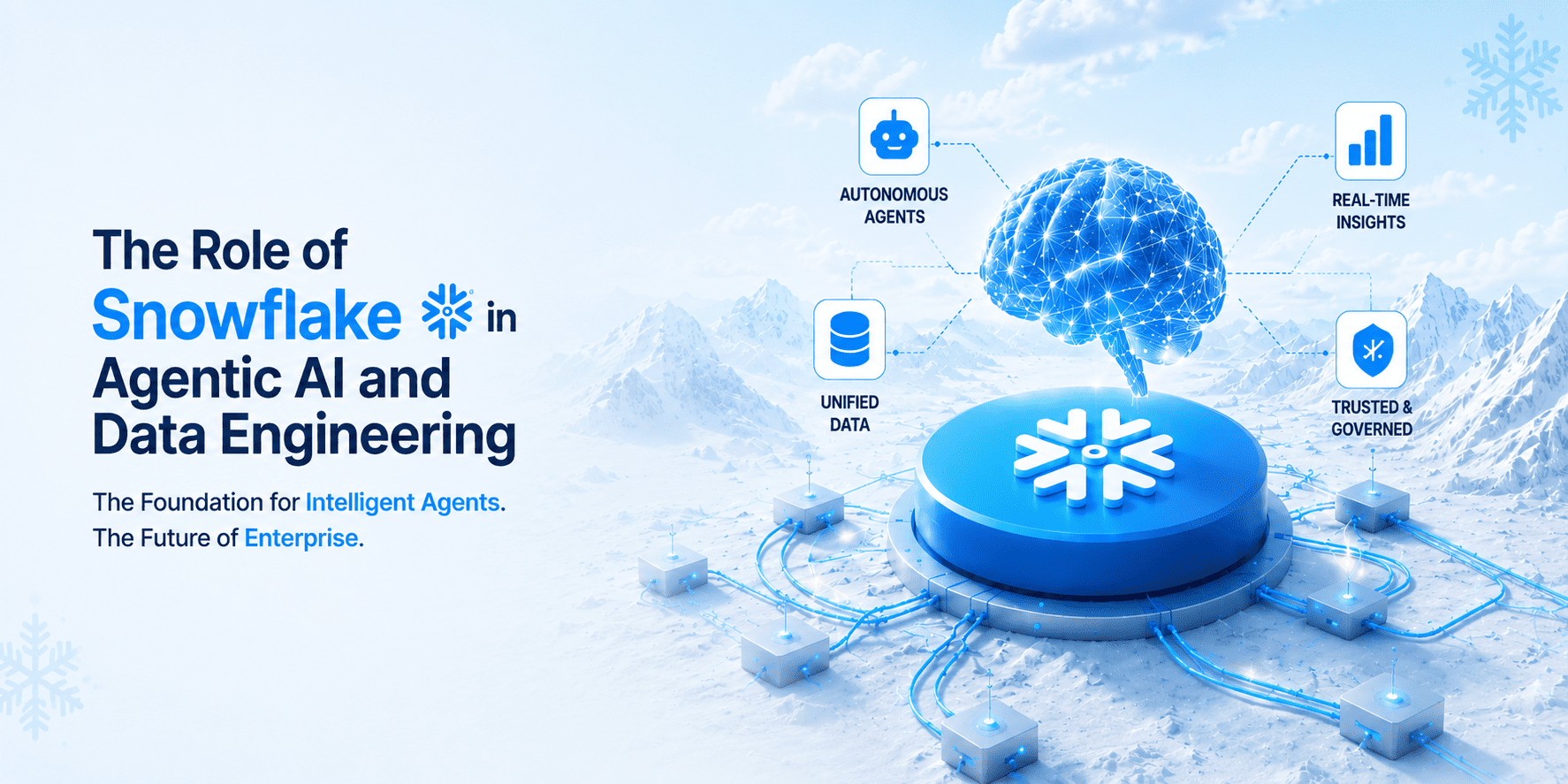
Legacy data systems significantly restrict AI’s ability to autonomously function. In fact, Gartner reports that by 2027, over 40% of agentic AI projects will fail because legacy systems cannot support modern AI execution demands. This bottleneck costs organizations in decision-making timeframes, IT costs, and even prevents enterprises from achieving an adequate ROI on their AI implementation plan. Snowflake, on the other hand, acts as a unified platform for agentic AI and data engineering, with built-in governance and a semantic model layer that addresses the root cause of AI investment failures. Before we dive deeper into the role of Snowflakes in agentic AI and data engineering, let’s understand why enterprises across industries are investing in agentic AI in the first place.
What is Agentic AI and Why is Everyone Talking About It?
An agentic AI system can carry out tasks efficiently and autonomously with minimal to no human intervention. Such a system includes AI agents and machine learning models that mimic human decision-making to solve problems in real time and take action autonomously. For enterprises, this means lower infrastructure costs, faster execution, reduced workload on employees, minimal need for manual intervention, and accelerated data-backed decision-making.
So why are many enterprises still struggling to lay a profitable agentic AI workflow in place?
The problem is not in their AI capabilities! The issue lies deeper. The reality is that most enterprises do not have a data foundation that is ready for agentic AI execution.
Even though 94% of organizations are currently exploring or implementing AI, only 15% consider their data foundation to be “very ready” for the shift toward Agentic AI.
Study conducted by Harvard Business Review Analytic Services
That is why, before committing huge numbers to AI investments, it is important to assess how ready an organization’s data infrastructure is. In this article, we will discuss in detail how legacy data systems curb organizations’ Agentic AI progress. And how Snowflake’s unified data platform can help drive quantifiable ROI, profit margin impact, and business outcomes that matter to executives making data infrastructure investment decisions.
Why Do Most Agentic AI Initiatives Struggle to Deliver Business Value?
1. Slow Data Access Slows Decision-Making
Decision delays mean missed opportunities. According to Forbes, analytics teams spend 80% of their time on data preparation, with data cleaning alone accounting for over 26% of workdays. Globally, data analysts spend on average 10.57 hours per week organizing data. This cuts into the time needed for actual data analysis. Gartner reports that poor data quality costs businesses an average of $12.9 million annually. One chief data officer reported his 500-person team spends 1,200 cumulative hours per week tackling data quality issues alone. These numbers are alarming from a business standpoint. With 25% of organizations losing more than $5 million US dollars annually, and 7% reporting losses of $25 million or more, business leaders should seriously consider how the lack of data quality is affecting their ROI.
Apart from data quality and data preparedness affecting the decision-making timeline, legacy systems also present significant challenges in presenting real-time data. Legacy systems carry out batch ETL processes that create overnight update cycles. This inhibits business users from getting real-time answers, and data specialists are then forced to write complex SQL queries for even simple questions because data preparation takes a significant amount of time.
2. Fragmented Data Sources Create Inconsistent Decisions
Most organizations generate a bulk of data from various offline and online systems. Since customer and product data stay scattered across ERPs, Excel spreadsheets, and catalogs, most often organizations are forced to make decisions based on incomplete information. Such incomplete, inaccurate, or siloed data can cost a company up to 30% of its annual revenue. IDC reports that 7 in 10 IT and business leaders cite data silos as one of the biggest challenges for AI adoption. Making sense of unstructured and fragmented data across multiple systems and databases prevents analysts from making a unified analysis.
3. Legacy Systems Block AI Autonomy
AI agents cannot work autonomously when legacy APIs lack real-time capabilities. This creates a fundamental bottleneck: you cannot deploy production AI agents on infrastructure designed for batch processing. 88% of AI agents fail to reach production deployment because they collapse when working with real enterprise systems featuring messy state and inconsistent APIs. Old systems are not built for AI. They block agents from accessing real-time data. Legacy APIs don’t support the synchronous, low-latency workflows that agentic AI requires.
4. Infrastructure Costs Multiply with Tool Sprawl
Managing multiple separate tools for structured data and unstructured data creates 3x higher operational costs. Typically structured data (eg, rows and columns, SQL tables, spreadsheets, etc.) and semi-structured data (JSON, XML, CSV, tagged records, event logs, etc.) are stored in relational databases and data warehouses. Whereas, unstructured data (like documents, call transcripts, images, audio, web pages, media files, etc.) is stored in data lakes or NoSQL stores, etc., while lakehouse/analytics platforms bring both together for BI and AI. This is an extreme case of tool sprawl. The resulting unpredictable cloud spending makes ROI difficult to forecast. Separate tools for structured and unstructured data mean no unified governance. Organizations must manage multiple infrastructure layers, security policies, and maintenance overhead.
This is a very common scenario for enterprises worldwide, with Semarchy’s study reporting that 51% of leaders currently implement AI initiatives without master data management foundations, creating redundant investments.
Looking to maximize the ROI of your Agentic AI investments?
Get Expert Guidance Here
Why Should These Problems Matter for Decision Makers?
For many organizations, the conversation around Agentic AI focuses solely on models, copilots, and automation capabilities. However, the reality is that the success of any AI initiative is determined long before an AI agent is even deployed. It depends on the quality, accessibility, and governance of the data foundation that powers it. This is reflected in the outcomes organizations are seeing today. According to Forrester, only 15% of organizations achieve measurable ROI from their AI investments. While AI technologies continue to advance rapidly, most enterprises struggle to translate those investments into tangible business outcomes. The gap is rarely caused by limitations in AI models themselves. Instead, it stems from fragmented data environments, poor data quality, disconnected legacy systems, and inadequate governance frameworks.
The challenge is significant enough that 51% of organizations now identify data management as their single most pressing business issue, surpassing concerns around cost management and talent shortages, according to a recent Semarchy study. As organizations scale their AI initiatives, the complexity of managing structured, semi-structured, and unstructured data across multiple systems only increases.
For decision makers, these challenges directly impact business performance and profit margins. As we have already discussed, slow access to trusted data delays decision-making, and data silos create conflicting insights across departments. Legacy infrastructure increases operational costs while limiting automation opportunities. Most importantly, these issues prevent AI agents from operating autonomously at scale, reducing them to isolated experiments rather than enterprise-wide productivity drivers. Organizations that address their data foundation before implementing Agentic AI workflows gain a significant advantage. They are able to deploy AI faster, govern it more effectively, and generate measurable business value from their investments. As Agentic AI adoption accelerates, the question for leaders is no longer whether to invest in AI or not, but whether their data infrastructure is capable of supporting it.
How Snowflake can act as the Foundation for Agentic AI?
Snowflake positions itself as the unified data platform that solves the foundational problems preventing agentic AI success. Rather than treating AI as a separate layer, Snowflake integrates AI capabilities directly into the data platform, addressing the root causes of AI investment failures.
-
Snowflake, The Unified Data Layer
One of Snowflake’s biggest advantages for enterprises is its ability to unify structured, semi-structured, and unstructured data within a single platform. Instead of maintaining separate databases, data lakes, analytics platforms, and document repositories, organizations can manage all their data through a single secure interface. This reduces tool sprawl, simplifies governance, and can lower software licensing and operational costs, paying only for actual usage. One of their customers, ESO, reported a 64% reduction in monthly infrastructure costs and a 60% reduction in monthly spend after moving to Snowflake. For business leaders, this means fewer vendors to manage, lower infrastructure complexity, and a more predictable path to AI adoption.
From a technical perspective, Snowflake provides a cohesive architecture that natively supports relational data, JSON, logs, documents, and other variant data types without requiring separate systems. Because the platform is fully managed, organizations do not need to provision servers, tune infrastructure, or manually scale resources as workloads grow. Snowflake automatically scales compute and storage independently, enabling teams to focus on delivering analytics and AI outcomes rather than managing underlying infrastructure. This unified foundation is particularly valuable for Agentic AI, where agents must seamlessly access and reason over multiple types of enterprise data in real time.
-
Self-Service Analytics For Non-Technical Users
One of the biggest barriers to data-driven decision-making is the dependency on technical teams to answer business questions. When executives, operations teams, or department leaders need insights, requests often flow through analysts or IT teams, creating delays that slow business response times. Snowflake addresses this challenge by enabling business users to interact with data directly using natural language. Instead of waiting for reports or custom queries, users can ask questions in plain English and receive answers immediately. This significantly accelerates decision-making, with Snowflake customers reporting a 30–40% increase in self-service analytics adoption and substantially faster access to actionable insights.
Behind the scenes, Snowflake Cortex Analyst uses large language models (LLMs) to convert natural language questions into SQL queries that can be executed against enterprise data. Semantic models defined in YAML act as a translation layer, mapping business terminology such as “customer churn” or “monthly revenue” to the underlying database schemas and metrics. The platform also supports multi-turn conversations, allowing users to ask follow-up questions and refine their analysis without writing SQL or involving technical teams. This makes enterprise data more accessible while maintaining consistency, governance, and accuracy across the organization.
-
Real-Time Insights Enable Faster Decisions
Traditional analytics environments often rely on batch processing and scheduled refresh cycles, forcing business users to wait hours or even days for updated reports. These delays directly impact decision-making, especially in fast-moving industries where opportunities and risks emerge in real time. Snowflake addresses this challenge by enabling near-real-time access to enterprise data, allowing organizations to act on the latest available information rather than outdated reports. As a result, Snowflake customers report 3–5x faster time-to-insight compared to traditional dashboard-based analytics environments, helping teams make quicker, more informed decisions while eliminating the reporting latency associated with overnight batch processes.
From a technical perspective, Snowflake Intelligence combines low-latency data access with AI-powered search and retrieval capabilities. Agentic rules and hybrid search mechanisms enable users and AI agents to quickly locate relevant information across enterprise datasets, while automatic index refreshes ensure newly generated data is immediately available for analysis. Snowflake has also continuously improved its query performance, with its Performance Index showing a 40% increase in query efficiency over the past 26 months. Together, these capabilities provide a foundation for real-time analytics and autonomous AI workflows, ensuring that both business users and AI agents can access accurate, up-to-date insights without complex data preparation or infrastructure bottlenecks.
-
Autonomous Workflows Reduce Manual Effort
One of the most significant advantages of Agentic AI is its ability to move beyond answering questions and begin taking actions autonomously. Instead of relying on employees to manually gather data, write queries, generate reports, and coordinate workflows, AI agents can independently break down objectives into smaller tasks, retrieve relevant information, and execute actions based on predefined rules. This significantly reduces operational overhead and accelerates business processes. Organizations leveraging Snowflake’s AI capabilities report up to a 60% reduction in manual SQL development and report creation efforts, allowing teams to focus on higher-value strategic initiatives.
Under the hood, Snowflake Cortex Agents orchestrate both structured and unstructured data sources to execute complex workflows. When a user submits a request, the agent determines the intent, plans the required subtasks, and automatically selects the appropriate tools, datasets, and retrieval methods needed to complete the objective. It can access enterprise databases, documents, and knowledge repositories, combine insights from multiple sources, and format responses appropriately for the user or downstream system. By automating task planning, tool selection, data retrieval, and response generation, Cortex Agents provide the foundation for enterprise-grade Agentic AI workflows that operate with minimal human intervention while remaining governed and secure.
-
Reduce Operational and Infra Costs
Managing data infrastructure often requires significant investments in servers, storage, scaling, performance tuning, and ongoing maintenance. These operational responsibilities consume valuable IT resources that could otherwise be focused on innovation and business transformation initiatives. Snowflake eliminates much of this burden through its fully managed platform, enabling organizations to reduce infrastructure management overhead while improving operational efficiency. By removing the need for dedicated infrastructure administration, businesses can lower operating costs and accelerate the delivery of analytics and AI initiatives. The impact can be substantial. Their client, Pfizer, a global leader in pharmaceuticals, reported a 57% reduction in total cost of ownership (TCO) while processing data four times faster after adopting Snowpark. They were able to save 19,000 hours annually with Snowflake.
From a technical perspective, Snowflake’s cloud-native architecture automatically manages infrastructure provisioning, scaling, performance optimization, and resource allocation. Organizations do not need to manage servers, configure clusters, or manually scale workloads as data volumes grow. Compute and storage resources scale independently based on demand, ensuring consistent performance without operational intervention. Snowflake also continues to improve platform efficiency through ongoing performance optimizations, with its Snowflake Performance Index (SPI) demonstrating a 20% improvement in query duration for stable workloads. This combination of automation and performance optimization allows enterprises to focus on generating business value from data rather than managing the underlying infrastructure.
Is Your Data Foundation Ready for Agentic AI?
Schedule a Consultation Call
The ROI Breakdown: Quantifiable Business Benefits
| Decision Speed Improvements | |||
|
Metric |
Before Snowflake | After Snowflake | Impact |
| Time for simple data questions | Days | Minutes | 3-5x faster time to insights |
| Ad-hoc request volume | Ad-hoc request volume 100% baseline |
30-50% of baseline | 50-70% reduction in ad-hoc requests |
| Manual SQL creation | 100% baseline | 40% of baseline | Up to 60% reduction |
|
Cost Reduction Benefits |
|||
|
Metric |
Before Snowflake | After Snowflake | Impact |
| Infrastructure costs | Multiple tools | Unified platform | 25% lower cloud spend |
| TCO (Total Cost of Ownership) | Baseline | 43% of baseline | 57% TCO reduction |
| Infrastructure costs | Multiple tools | Unified platform | 25% lower cloud spend |
| IT dependency | High manual effort | Self-service | $150K–$300K/year IT savings |
| Data team productivity | 30-40% on quality issues | 70-80% on insights | 66% improvement in data engineering productivity |
| Revenue and Profit Impact | |||
|
Metric |
Before Snowflake | After Snowflake | Impact |
| Incremental revenue | Baseline | 106% of baseline | 6% increase in addressable revenue |
| Revenue loss from poor data | 15-25% | Reduced | 15% profit margin improvement potential |
| Annual ROI | N/A | 354% over 3 years | $24.9M total benefits |
How Does Snowflake’s Agentic AI Framework Work?
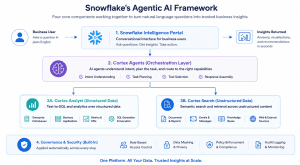
For business leaders, the value of Agentic AI lies in its ability to transform natural language questions into actionable insights without requiring technical expertise. Snowflake’s Agentic AI framework achieves this by combining AI-powered reasoning, data access, and governance within a single platform.
Step 1: A Business User Asks a Question
A sales leader can simply ask, “What were our Q3 sales by region, and which products are underperforming? ” SQL knowledge, analyst requests, or IT tickets are not needed for data retrieval and analysis.
Step 2: The AI Agent Determines Where the Data Lives
The Cortex Agent analyzes the request and identifies the most relevant data sources.
- Questions involving structured business data, such as sales, finance, or operational records, are routed to Cortex Analyst.
- Questions requiring information from documents, emails, reports, or knowledge bases are routed to Cortex Search.
Step 3: Insights Are Generated and Returned
Cortex Analyst automatically converts the business question into SQL queries and retrieves the required information from enterprise databases. At the same time, Cortex Search can retrieve relevant context from unstructured content. The results are combined and presented in seconds, enabling business users to move from question to insight without technical intervention.
Step 4: Security and Governance Are Applied Automatically
Throughout the process, Snowflake enforces existing security controls such as role-based access policies, data masking, and governance rules. Users only see information they are authorized to access, ensuring compliance and security without creating additional administrative overhead.
Major Industry Use Cases of Snowflake
Manufacturing
Manufacturers often struggle with fragmented data spread across ERP systems, production equipment, and IoT sensors, making real-time operational visibility difficult. By unifying these data sources, Snowflake enables faster operational analytics, predictive decision-making, and AI-driven automation. Organizations can achieve up to 30% faster operational decisions while significantly improving data engineering productivity.
Healthcare
Healthcare organizations manage vast amounts of patient, clinical, and operational data across multiple systems. This fragmentation creates compliance challenges and limits the effectiveness of AI initiatives. Snowflake provides a secure and governed platform that unifies healthcare data, enabling faster access to insights, improved regulatory compliance, and greater self-service across teams.
Pharmaceuticals
Pharmaceutical companies generate vast amounts of data across clinical trials, research and development, manufacturing, supply chains, and regulatory systems. These datasets often remain siloed, limiting visibility and slowing critical decision-making. Snowflake helps unify research, operational, and commercial data on a single platform, enabling faster drug development, improved supply chain visibility, enhanced regulatory reporting, and AI-driven insights. By providing secure and governed access to enterprise data, Snowflake accelerates innovation while supporting compliance requirements.
Insurance
Insurance providers manage large volumes of policy, claims, customer, risk, and third-party data distributed across multiple legacy systems. This fragmentation can delay underwriting decisions, claims processing, fraud detection, and customer service. Snowflake enables insurers to consolidate data into a unified platform, providing a comprehensive view of customers and operations. This supports faster claims resolution, more accurate risk assessment, improved fraud detection, personalized policy offerings, and AI-powered automation that enhances both operational efficiency and customer experience.
Retail
Retailers often struggle to build a complete customer view because customer interactions, transactions, and behavioral data reside across multiple platforms. Snowflake helps consolidate these datasets into a unified customer profile,
enabling more personalized experiences, better targeting, and improved business intelligence. Organizations also benefit from increased self-service analytics adoption across business teams.
Financial Services
Banks, insurers, and financial institutions depend on real-time access to trusted data for risk management, fraud detection, and regulatory reporting. Snowflake enables near-real-time analytics and supports AI-driven decision-making while reducing manual reporting effort through automation and governed data access.
Media and Streaming
Media companies generate large volumes of structured performance metrics alongside unstructured content such as videos, transcripts, and audience feedback. Snowflake enables unified analysis across both data types, helping organizations uncover content performance insights, improve audience engagement, and accelerate monetization strategies through faster access to business intelligence.
Looking to implement Snowflake Agentic AI workflow for your Industry?
Book a discovery call with us
How do we Implement Snowflake in Agentic AI workflows for your Business?
Successfully adopting Snowflake requires more than just deploying a platform. It requires aligning data architecture, governance, and AI capabilities with business objectives. At Travancore Analytics, we are experts at implementing Snowflake for enterprises of any scale to achieve maximum agentic AI ROI. We help organizations accelerate their Snowflake journey through a structured implementation approach that minimizes risk and maximizes ROI.
Our Approach
1. Assess Data Readiness
We evaluate your current data landscape to identify fragmentation, data quality issues, governance gaps, and AI-readiness challenges that could impact business outcomes.
2. Consolidate and Modernize Data
Our team integrates structured, semi-structured, and unstructured data sources into Snowflake, creating a unified and scalable foundation for analytics and AI workloads.
3. Build Semantic Models for Business Users
We design business-friendly semantic layers that map organizational terminology to underlying data assets, enabling natural-language analytics and self-service insights.
4. Configure AI Agents and Workflows
We implement and customize Snowflake Cortex capabilities to support use cases such as conversational analytics, intelligent search, automated reporting, and Agentic AI workflows.
5. Establish Governance and Adoption Frameworks
We implement role-based access controls, data governance policies, security frameworks, and user enablement programs to ensure secure and scalable adoption across the enterprise.
6. Deploy Agentic AI Workflows
Once the data foundation, semantic models, and governance framework are in place, we design and deploy Agentic AI workflows tailored to your business processes. This includes configuring AI agents, integrating enterprise data sources and business applications, defining decision logic, and enabling autonomous task execution to drive measurable productivity and operational gains.
Depending on data complexity and organizational readiness, most Snowflake implementations can be delivered within 3–6 months, with measurable business outcomes typically realized within the first 6 months through improved decision-making, reduced operational overhead, and accelerated AI adoption. Beyond implementation, we help organizations execute Agentic AI at scale, transforming Snowflake from a data platform into an intelligent decision-making engine.
FAQs
- What Is Snowflake’s Role in Agentic AI?
Snowflake provides the unified data foundation that Agentic AI systems need to operate effectively. By bringing together structured, semi-structured, and unstructured data on a single platform, Snowflake enables AI agents to securely access, analyze, and act on enterprise data in real time.
- Can Snowflake Be Used for AI Agents?
Yes. Snowflake offers native capabilities such as Cortex Agents, Cortex Analyst, and Cortex Search that allow organizations to build, deploy, and manage AI agents. These agents can retrieve information, answer questions, automate workflows, and support business decision-making while adhering to enterprise governance policies.
- How Does Snowflake Support Agentic AI?
Snowflake supports Agentic AI through a combination of data unification, semantic models, AI-powered analytics, vector search, and agent orchestration capabilities. This enables AI agents to understand business context, access relevant data sources, and perform tasks autonomously without requiring extensive manual intervention.
- What Is Snowflake Cortex?
Snowflake Cortex is Snowflake’s suite of AI and machine learning services. It includes capabilities such as Cortex Analyst for natural-language analytics, Cortex Search for semantic retrieval across unstructured content, and Cortex Agents for orchestrating AI-driven workflows. Together, these services enable organizations to build enterprise-grade AI applications directly within Snowflake.
- How Can Enterprises Implement Agentic AI Successfully?
Successful Agentic AI implementation begins with a strong data foundation. Organizations should first address data quality, governance, accessibility, and system integration challenges before deploying AI agents. A typical implementation involves consolidating data into a unified platform such as Snowflake, defining semantic models, establishing governance controls, and then configuring AI agents to support specific business processes and decision-making workflows.
- Why Is Data Engineering Important for Agentic AI?
Agentic AI is only as effective as the data it can access. Data engineering ensures that information is accurate, accessible, governed, and available in real time. Without a strong data foundation, AI agents struggle with incomplete context, inconsistent outputs, and limited autonomy.
- What Are the Benefits of Building Agentic AI on Snowflake?
By building Agentic AI on Snowflake, organizations can unify structured and unstructured data, reduce infrastructure complexity, improve governance, accelerate decision-making, and enable secure AI-driven automation at scale. This helps maximize the ROI of AI investments while minimizing operational overhead.
- How Long Does It Take to Implement Snowflake for Agentic AI?
Implementation timelines vary depending on data complexity, integration requirements, and business objectives. Most organizations can establish a Snowflake-based data foundation and begin deploying AI use cases within 3–6 months, with measurable business outcomes often realized within the first six months of adoption.
Ready to turn your idea into a powerful digital solution?
Partner with our experts to design, build, and scale technology tailored to your business goals.
Contact us Today