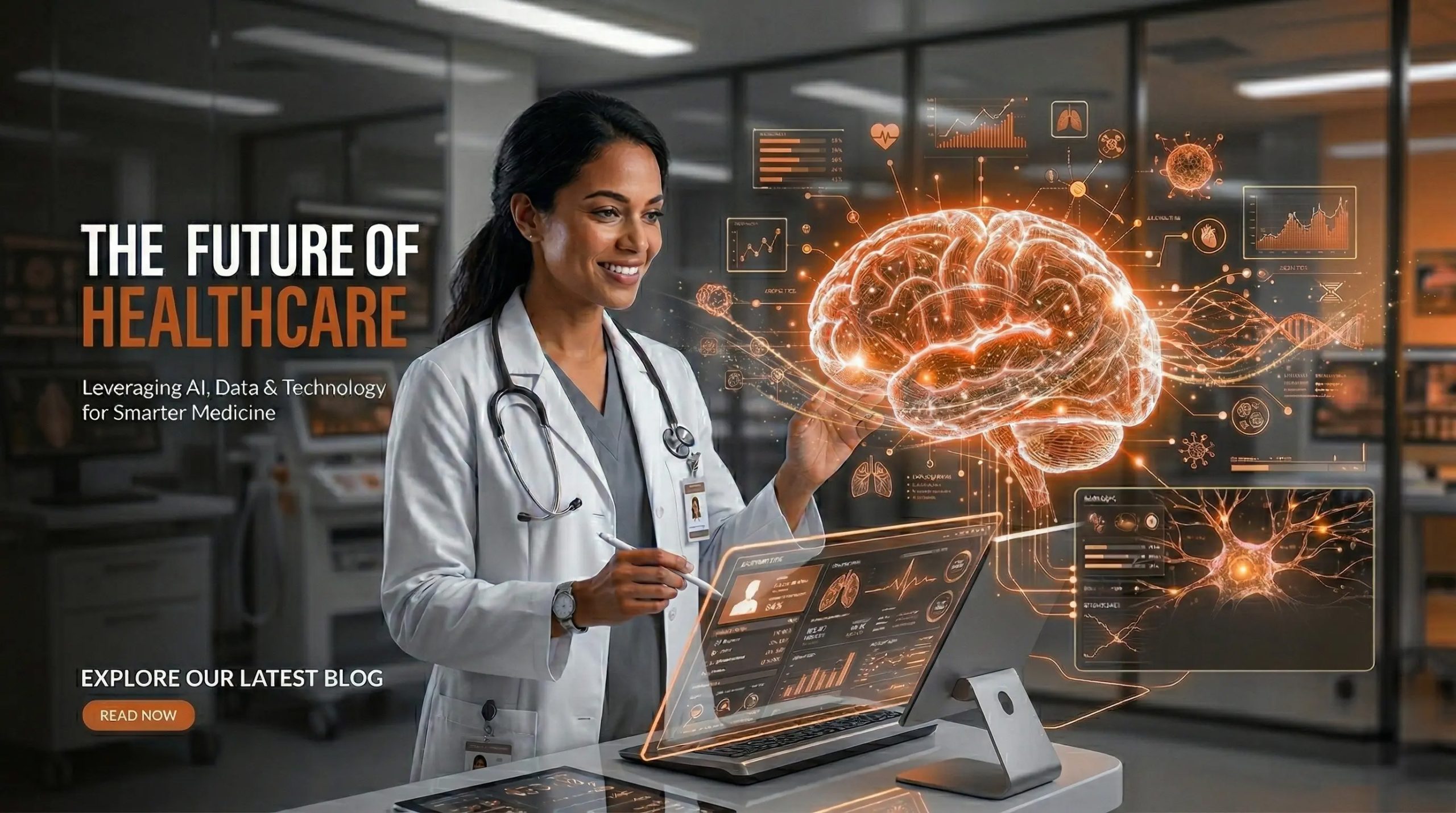
Artificial intelligence has spread its roots deep into all industries, with the healthcare industry embracing this transformation wholeheartedly. And the number reflects this! According to a recent study done by Precedence Research, the global AI healthcare market size, which was at 37 billion US dollars in 2025, is projected to reach a substantial 613 billion US dollars by the year 2034. Integrating AI in healthcare can improve patient care, streamline operations, and drive innovation significantly. AI is already actively being used by many healthcare giants in most aspects, like diagnosis, treatment planning, medical imaging analysis, and wearable devices. It has diverse applications in drug development, patient care, diagnostics, and medical research. This article highlights the impact of artificial intelligence in healthcare organizations and the life sciences industry as it explores the possible use cases and benefits of AI in healthcare.
Why use AI in Healthcare?
Artificial intelligence in healthcare refers to the use of machine learning, natural language processing, and data analytics to improve diagnosis, treatment, operations, and patient outcomes.
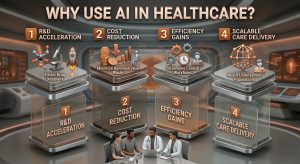
1. R&D Acceleration
R&D efficiency in healthcare could be significantly improved by accelerating every stage of the drug discovery and development lifecycle with AI. By using advanced machine learning models, AI can improve target identification by analyzing genomics, proteomics, and biological pathways to pinpoint druggable targets with high precision. This reduces early discovery timelines from years to months. According to a study done by Tempus, generative AI can design new molecules or potential drugs, predict their binding affinity, and simulate molecular interactions without a physical lab. This increases the number of viable candidates by up to 10 times compared to traditional manual screening methods. It scans EHRs to identify suitable clinical trial participants, screening out ~72% of ineligible patients before full review. This improves recruitment-to-enrollment rates by up to 65% per industry benchmarks.
Additionally, its toxicity and safety prediction are improved through machine learning models that identify potential adverse effects early in the development process, minimizing costly late-stage failures that can exceed billions per drug.
2. Cost Reduction
AI helps cut healthcare costs by automating tasks like scheduling, documentation, billing, and claims processing, reducing the need for extra staff and lowering the chances of errors. It also improves efficiency by analyzing workflows and optimizing resource use. With more accurate data entry and faster insurance processing, AI speeds up payments and reduces financial risks. Additionally, by supporting more accurate diagnoses and treatment plans, AI helps avoid unnecessary tests and costly mistakes. Overall, it streamlines operations and improves the financial health of healthcare organizations.
3. Efficiency Gains
Healthcare operational efficiency could be remarkably improved by streamlining workflows and enabling faster, data-driven decision-making. It can analyze historical patient data and real-time symptoms to forecast hospital admissions and predict bed requirements. This would help hospitals reduce emergency room wait times by up to 22% and cut staff overtime by 15%. In diagnostics, AI-powered imaging analysis can detect abnormalities up to 30% faster than traditional methods, allowing for quicker diagnoses, earlier interventions, and increased patient throughput. Administrative automation further enhances efficiency by handling routine tasks such as appointment coordination, invoicing, and coverage validation, reducing paperwork, and enabling clinicians to focus more on patient care. Additionally, AI agents can reduce the time required for clinicians to scribe, document, and dictate information by acting as a virtual scribe, automatically generating clinical notes directly from doctor-patient conversations.
AI also supports capacity optimization through real-time analytics that improve bed utilization by up to 18%, helping hospitals manage resources more effectively and reduce bottlenecks during peak demand. These capabilities enable healthcare providers to deliver faster, more efficient, and higher-quality care while optimizing operational performance.
4. Scalable Care Delivery
AI helps healthcare organizations in scaling their capabilities by allowing providers to deliver high-quality services to larger populations without proportionally increasing resources. It also enables efficient remote patient monitoring by analyzing data from wearables and connected devices to detect anomalies in chronic conditions. This aids patients in receiving proactive virtual care that is scalable to up to millions of patients without requiring additional staff. AI agents can handle large volumes of patients and act as a first point of contact through chat or voice interfaces. They could assess the situation and navigate triage to enhance scalability and care delivery around the clock while ensuring timely routing to appropriate care providers. Multimodal AI systems could combine data from medical images, EHR, wearables, etc., to assign personalized risk scores and automate tailored care plans at scale.
Economic Times reports AI integration with hospital administrative workflows to automate processes from appointment scheduling to follow-ups, which can reduce human intervention and boost employee productivity by over 14 percent. Additionally, interoperable AI platforms support value-based care models by delivering explainable insights and measurable outcomes, enabling healthcare providers to scale services while maintaining quality and compliance. Together, these capabilities ensure that healthcare systems can expand access, improve efficiency, and deliver consistent patient care at scale.
Who Should be Using AI in Healthcare?
We have already explored how integrating AI in healthcare could improve operational efficiency while cutting costs. Now lets explore who should be investing in healthcare AI solutions.
- HOSPITALS: Healthcare organizations such as hospitals, nursing facilities, and clinics can leverage AI to simplify and streamline processes like appointment scheduling and tracking, care planning, and remote patient monitoring. By integrating AI into their existing hospital administrative systems, physicians can access comprehensive, real-time patient information to support more informed decision-making. Meanwhile, patients can use AI-powered chatbots to retrieve past treatment and admission records, as well as get quick answers to questions about lab results, medications, and other immediate concerns.
- PHARMACEUTICAL COMPANIES: Pharmaceutical companies can leverage AI to improve their R&D processes. They can speed up drug discovery and clinical trials by identifying targets, designing molecules, and optimizing patient recruitment and study design.
- PUBLIC HEALTH DEPARTMENTS & GOVERNMENTAL AGENCIES: Public health and government agencies can use AI to enable real-time disease surveillance by analyzing data from hospitals, labs, and pharmacies. This will help detect early signs of outbreaks and predict how diseases may spread. They’ll be able to forecast resource requirements like vaccines, hospital beds, and staff allocation. This could support proactive planning efforts. AI also identifies high-risk populations and optimizes targeted interventions like vaccination drives and screening programs.
- HEALTHCARE SOLUTION PROVIDERS: Healthcare solution providers can transform generic platforms into intelligent, outcome-driven products by integrating AI. Across clinical, operational, and administrative workflows, AI enables predictive risk detection, enhances clinical decision support, and personalizes patient care. This improves outcomes and user engagement. Integrating AI into your healthcare application can also automate documentation, optimize resource utilization, and strengthen diagnostics. AI-powered virtual care and real-time monitoring help providers deliver scalable, efficient, and trusted healthcare solutions.
Top 7 Use Cases of AI in Healthcare & Pharmaceuticals
- Clinical Decision & Diagnostics Support
- Medical Imaging
- Accelerated Drug Discovery
- Personalized Treatment Planning
- Remote Monitoring
- Administrative Automation
- Documentation
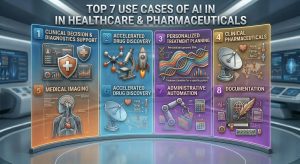
1. Clinical Decision & Diagnostics Support
The clinical decision-making process could be elevated by adopting AI to enable faster, more accurate, and personalized care through advanced data analysis and real-time support. AI can create a unified data interface by integrating data from electronic health records, lab results, medical imaging, and genomics. This interface helps in surfacing patterns & insights often missed by human analysis and gives a comprehensive view of patient history & previous treatment plans. This leads to quicker and more precise diagnoses. It can continuously analyze EHRs in real time to support diagnosis, oncology treatment planning, and dynamic risk scoring, helping clinicians make more informed decisions at every stage of care. AI systems can also analyze symptoms and lab data to provide preliminary insights, aiding early triage and prioritizing patients based on urgency.
Predictive models further enhance decision-making by forecasting potential complications such as sepsis or hospital readmissions, enabling proactive interventions instead of reactive care. Generative AI supports personalized treatment planning by matching individual patient profiles with outcomes data to recommend an optimal treatment course, including precise drug selection and dosage. During consultations, AI-powered workflow support tools can provide real-time insights and recommendations, reducing cognitive load on the clinicians. This minimizes human-made errors, especially in critical and high-pressure environments. Together, these capabilities empower clinicians to deliver more informed, efficient, and high-quality patient care.
2. Medical Imaging
Medical imaging analysis should be carried out with AI. The AI engine can help by facilitating anomaly detection and faster diagnosis. Advanced algorithms can scan X-ray images, CT scans, and MRI images faster than radiologists to identify critical conditions such as tumors, fractures, or pulmonary embolisms. The algorithm often achieves sensitivity levels above 90% (Source). This allows urgent cases to be flagged immediately, enabling quicker clinical intervention. AI can enhance image reconstruction by using deep learning (DL) techniques to generate high-quality diagnostic images from undersampled data. This can reduce scan times by up to 50% while minimizing distortions, which is especially beneficial for patients who struggle to remain still during procedures.
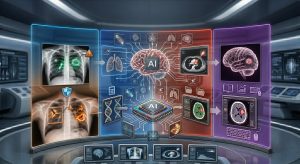
In addition, workflow prioritization is significantly improved as AI systems can automatically triage imaging cases based on severity. For example, detecting intracranial bleeds in real time ensures that high-risk cases are reviewed first, reducing radiologist workload and minimizing delays in emergency care. Multimodal integration allows AI to combine imaging data with electronic health records and genomic information, providing a more comprehensive view of the patient. This enables deeper insights, such as linking MRI patterns with underlying genetic mutations, supporting more precise diagnoses and personalized treatment planning.
3. Accelerated Drug Discovery
Drug discovery could be sped up by streamlining each stage of the research and development lifecycle, reducing time, cost, and risk with AI/ML algorithms. In the early stages, AI analyzes multi-omics data, including genomics and proteomics, to identify viable drug targets with high precision. This approach cuts target identification timelines from years to months through predictive modeling. Generative AI further enhances this process by designing new molecular compounds with optimal binding affinity, achieving hit rates of 16 to 20 percent compared to traditional methods that often yield only 0.1 percent.
During preclinical optimization, AI-driven simulations predict both efficacy and toxicity, enabling researchers to refine candidates more efficiently. AI can compress development timelines to approximately 13 to 18 months, which is 30 to 40 percent faster than conventional approaches. As we have already discussed, AI leverages EHRs to match suitable patients to clinical trials, improving recruitment-to-enrollment rates by up to 65% while screening out ~72% of ineligible patients before full review. These improvements ensure that trials are conducted faster and with greater precision. Overall, AI-driven drug discovery can reduce R&D costs by 30 to 80 percent, making the process more sustainable and scalable. With the AI-driven drug discovery market expected to reach 8 to 10 billion dollars by 2026 and the first AI-developed drug approvals anticipated by 2027, AI is set to redefine how new therapies are discovered and brought to market.
4. Personalized Treatment Planning
Personalized treatment planning enables highly tailored therapies based on comprehensive patient data and predictive insights. By integrating genetic information, electronic health records, and real-time health data, AI helps clinicians design individualized treatment plans. In genomic matching, AI analyzes genetic mutations and biomarkers to align patients with targeted therapies, achieving benefit rates as high as 83 percent in precision oncology platforms. This allows treatments to be more effective and specific to each patient’s condition. AI also supports dosage optimization through machine learning models that predict how individual patients will respond to medications. With dynamic adjustment of dosages, patients can maximize efficacy while minimizing adverse reactions. In addition, predictive outcome modeling uses historical and real-world data to simulate multiple treatment pathways, ranking them based on likely effectiveness. This is particularly valuable for complex conditions such as cancer.
For chronic disease management, AI continuously integrates data from wearables, lifestyle inputs, and lab results to create adaptive care plans for conditions like diabetes and heart disease. These plans evolve over time as patient conditions change, ensuring continuous optimization of care. Overall, AI-driven personalized treatment planning improves clinical outcomes, reduces trial-and-error approaches, and supports more precise, data-driven decision-making in modern healthcare.
5. Remote Monitoring
Monitoring patients provides physicians with continuous, real-time insights that improve patient care delivery even outside the hospital premises. This significantly reduces the burden on healthcare systems. By analyzing data from wearables and connected sensors, AI can track vital signs such as heart rate, oxygen levels, and activity patterns, etc. These parameters help in detecting early signs of deterioration up to 7 to 10 days in advance. This allows clinicians to intervene proactively, preventing complications. Studies show that AI‑enabled remote monitoring reduces hospital readmissions by up to 38 percent, especially for patients with chronic conditions.
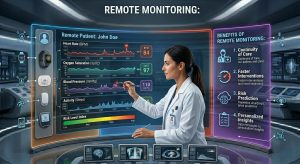
ML models can stratify patients into distinct groups based on the severity of their conditions to assign predictive risk scores and their subsequent priority levels. The risk scores are assigned based on their likelihood of adverse events, particularly in conditions like COPD and diabetes. This enables automated triage, ensuring that high-risk patients receive timely attention while reducing unnecessary emergency room visits. AI also improves patient engagement through chatbots and natural language processing tools. These tools effectively collect data on patient symptoms and medications to provide personalized reminders, encouraging patients to stay on track with their care plans. Additionally, integration and scalability are achieved through interoperability standards such as FHIR and HL7 APIs, which connect remote monitoring systems with EHRs. This allows healthcare providers to manage large-scale monitoring programs efficiently, particularly for aging populations and patients requiring long-term care. Overall, AI-driven remote monitoring enables more proactive, scalable, and patient-centric healthcare delivery.
6. Administrative Automation
Automating administrative tasks in healthcare with AI can help reduce manual workload, improve accuracy, and enable clinicians to focus more on patient care. 78% of U.S. hospitals are already embracing AI-powered tools, saving up to 2.5 hours of physicians’ daily time that would otherwise be spent on administrative tasks. This is essential in reducing burnout. In claims processing, AI automates validation and submission with accuracy levels as high as 99.5 percent. This significantly cuts down claim denials and saves thousands of staff hours each month. Scheduling optimization is another key area where AI adds value. AI can personalize appointment slots based on patient preferences and provider availability, while sending predictive reminders to reduce no-shows and improve resource utilization.
AI also streamlines prior authorization processes by using NLP to analyze medical records against insurance guidelines, automatically generating approvals and reducing processing time from days to minutes. This approach also significantly improves financial performance. In medical coding and billing, AI can extract relevant medical codes directly from clinical notes, ensuring more accurate documentation. This ensures faster reimbursements and improved compliance with regulatory standards (Source). Together, these capabilities enhance operational efficiency across healthcare systems and reduce administrative bottlenecks. By automating repetitive and time-consuming tasks, AI allows healthcare providers to allocate more time and resources toward delivering high-quality patient care.
7. Documentation
Healthcare documentation can be automated to avoid time-consuming, recurring tasks while improving accuracy and reducing the administrative burden on clinicians. Through ambient scribing and NLP, AI can reduce after-hours documentation time while ensuring more precise and consistent records. Ambient scribing allows AI to listen to doctor-patient conversations and automatically generate structured notes for electronic health records, reducing after-hours documentation and minimizing clinician burnout. AI also enhances coding extraction by using NLP to identify and assign ICD-10 and CPT codes directly from free-text clinical notes. Studies show that the ICD-10 accuracy actually reaches up to 99%, streamlining billing workflows and reducing manual errors. In addition, generative AI supports the creation of discharge summaries by converting complex medical information into clear, patient-friendly language. This approach improves patient understanding and adherence to treatment plans.
AI further contributes to error reduction by continuously scanning documentation for inconsistencies, missing information, or discrepancies across records. Healthcare organizations can thus maintain compliance and reduce risks during audits. Overall, AI-driven documentation solutions enable faster, more accurate, and scalable record-keeping, allowing clinicians to focus more on patient care while improving operational efficiency and regulatory compliance across healthcare systems.
Frequently Asked Questions You May Have
Have questions about Artificial intelligence in healthcare?
We’ve compiled answers to some of the most common queries to help you make informed decisions and better understand the process, benefits, and considerations involved.
1. What are the main uses of AI in healthcare?
AI can help elevate healthcare service delivery by improving efficiency through the automation of routine administrative tasks. It can also accelerate drug discovery and diagnosis, and reduce manual error in critical areas like medical imaging analysis. In addition to that, AI can personalize patient care plans, lift the administrative burden, and ultimately reduce burnout in doctors.
2. How does AI improve patient care?
AI improves patient care by enabling earlier and more accurate diagnoses through analysis of medical images and health records. It personalizes treatment plans by combining genetic, lifestyle, and clinical data, leading to more effective therapies with fewer side effects. By automating administrative tasks and supporting remote monitoring, AI reduces delays and errors while freeing up clinicians to spend more time directly with patients.
3. Is AI in healthcare safe?
AI in healthcare can be safe when it is well‑designed, rigorously validated, and used as a support tool rather than a replacement for clinicians. However, it also carries risks such as data bias, misdiagnosis, privacy breaches, and over‑reliance if systems are poorly trained, poorly monitored, or deployed without clear regulations. Safety ultimately depends on strong governance, transparent algorithms, and human oversight.
4. What are examples of AI in hospitals?
AI in hospitals helps monitor patients in real time, using early‑warning systems to detect conditions like sepsis and alert clinicians before a crisis. It supports diagnosis through AI‑assisted imaging tools that highlight abnormalities in X‑rays, CT scans, and MRIs. Hospitals also use AI for virtual assistants, predictive bed and staffing planning, and remote monitoring of chronic diseases to improve efficiency and patient outcomes.
5. How does AI reduce healthcare costs?
AI can improve diagnostic accuracy and support early‑intervention decisions, which lowers expensive hospitalizations, re‑admissions, and prolonged treatments. AI also automates tasks like billing, coding, and scheduling. It can also optimize hospital operations such as staffing, bed use, and supply chains, all of which can generate double‑digit percentage savings in system‑wide spending over time.
Future of AI in Healthcare
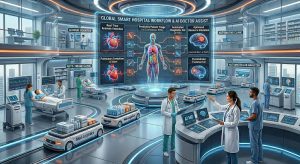
AI is no longer a futuristic concept in healthcare. It is already being integrated across the healthcare ecosystem. From accelerating drug discovery and diagnostics to enabling personalized treatment planning, AI is fundamentally redefining how healthcare is delivered. As we have explored, AI can process vast amounts of complex data, generate actionable insights, and automate repetitive tasks. This, in turn, helps healthcare organizations improve clinical outcomes while simultaneously optimizing operational efficiency.
Across the use cases we’ve assessed so far, we can see that AI is not just improving speed and accuracy but also enabling a shift from reactive to proactive care. Healthcare providers can now identify risks earlier, intervene faster, and deliver more personalized and continuous care at scale. And most importantly, automation of administrative workflows reduces clinician burnout and allows more focus on patient-centric activities.
However, the true value of AI lies in its ability to seamlessly integrate into existing systems and workflows while maintaining compliance, security, and trust. Organizations that strategically adopt AI today are better positioned to drive innovation, reduce costs, and deliver high-quality care in an increasingly complex and competitive landscape. As AI continues to evolve, it will play an even more critical role in shaping the future of healthcare.
Want to know how you too can integrate AI to elevate your healthcare operations?