According to McKinsey Global Institute, the manufacturing industry generates 1.9 petabytes of data on average every year. From maintenance to supply chain to quality evaluations, keeping diligent reporting systems is the go-to way manufacturers use to optimize operations. However, many times this turns overwhelming, with data being stored individually across several departments in multiple formats. Correlating this data to cross-check or extract specific data points becomes extremely difficult. The manual effort required to make sense of these disconnected systems often leads to either data blind spots or, even worse, grave analytical errors. Manual reporting also slows down decision-making and hinders proactive maintenance, leading to unprecedented delays and downtime. By leveraging a multi-agentic AI framework, DataLens adds context to data and supports real-time reporting. DataLens eliminates manual intervention in data correlation, analysis, and insight generation, thereby enabling prompt, data-backed decision-making.
Why Manual Reporting Still Dominates Manufacturing?
Manufacturers have long relied on legacy systems for data handling. This becomes a bottleneck when you realize that there are many moving parts in a typical manufacturing enterprise. Data from shop-floor operations, logistics, distribution, suppliers, inspection, and maintenance are often managed by individual departments as separate entities. This data is then pulled manually from disparate ERP (Enterprise Resource Planning), MES (Manufacturing Execution System), and SCM (Supply Chain Management) systems to generate reports.
These siloed data sources are often managed manually by authorized individuals using static dashboards, outdated systems, and Excel sheets. There is no visibility into real-time data and correlational parameters across these segments, which leads to an absence of contextual information. This results in delayed decisions, with reporting cycles taking days or sometimes weeks to generate meaningful reports. Even with heavy reliance on data analysts, reports often return inconsistent metrics and manual reporting errors.
The Limitations of Traditional BI in Manufacturing
These manual reporting errors became the primary reason for the adoption of Business Intelligence (BI) tools. BI tools offered a view into historical data, which helped, but manual interpretation of data across previous years was extremely challenging. Developed primarily for historical reporting and trend prediction, popular BI tools still lack operational intelligence. They operate within predefined query sets and preset dashboards. These tools lack real-time awareness and manufacturing context. Data collected across machines, sales systems, and inventory is not studied to establish dependency parameters. Most importantly, they still require high maintenance effort and strong data analytics knowledge to operate. This challenge scales further in large enterprises with multiple manufacturing centers and warehouses across locations. Having dashboards and historical data awareness alone is not sufficient for large and growing organizations. Manufacturing enterprises need intelligence that grows with them, offering real-time data visibility and the required context.
From Data Availability to Decision Readiness
As discussed, as organizations grow, data volumes grow substantially with them. In recent years, the manufacturing industry has reached a point where the volume of data generated by enterprises has outpaced human interpretation. 30% of firms have fully digitized reporting, underscoring the urgency for scalable data intelligence.
Organizations now collect, generate, and transfer more data than teams can analyze in time. Even with countless reports and dashboards, turning data into action still requires overcoming hurdles such as manual interpretation of trends, correlations, and implications.
With multiple systems and metrics, operational complexity increases, making it harder to identify what actually matters in a business context for data-backed decisions. Without intelligent filtering and prioritization, teams struggle to distinguish between critical data points and background noise.
Organizations do not want information to be presented as isolated monoliths without context and correlation. They need systems that contextualize data, highlight its relevance, and guide decision-makers toward actionable insights.
3.1 Why Data Integration Alone Is Not Enough?
Would integrating these disconnected, disparate data sources suffice? While it provides full transparency across data, it still does not offer a comprehensive view unless contextual information is included. Data alone is not enough to understand real-life operational scenarios. Data generated across production, quality, supply chain, and inventory lacks meaning without context. There must be awareness of relationships, causality, and operational impact; otherwise, teams remain burdened with the herculean task of manual data interpretation.
Even with dedicated data analytics and BI teams, the sheer volume of data poses a significant challenge for manual interpretation and correlation.
How DataLens Eliminates Manual Reporting?
So far, we’ve explored how data volumes have surpassed manual reporting capabilities and how, even with BI tools, teams still struggle with real-time visibility, contextual awareness, and operational intelligence. Now let’s see how DataLens overcomes these challenges and delivers 360° data intelligence to decision-makers, business owners, and analysts in the manufacturing industry.
DataLens connects to disparate sources, establishes relationships, performs automated analysis, and generates actionable insights.
4.1 Automated Data Ingestion & Contextualization
DataLens connects with ERP, MES, IoT edge devices, and supply chain systems. It establishes relationships between data points to visualize correlations and dependencies. This contextual awareness enables DataLens to explain why something happened rather than just what happened, eliminating the need for manual data preparation and interpretation.
4.2 Real-time Operational Visibility
Live data from production, inventory, and performance systems can be ingested into a central database, which, when integrated with DataLen,s provides a full 360° operational view. This near-live data is visualized through DataLens’s dynamic dashboards, enabling business owners and decision-makers to proactively intervene to mitigate risks or drive growth.
4.3 AI-powered Actionable Insights
With its multi-agentic AI framework, DataLens automates data analysis to derive actionable insights in business terms. From bulk data ingestion, it detects trends, anomalies, and inefficiencies. Leveraging ML and NLP, DataLens allows users to interact with data using natural language. This makes DataLens a self-service intelligence platform by providing no-code/low-code access, reducing dependence on analysts and IT teams.
Insights are surfaced automatically in near real-time, instead of relying on reports that take days to curate, enabling faster responses to issues and trends.
How DataLens Transforms Manufacturing Use Cases?
In the manufacturing industry, DataLens takes a multidisciplinary approach and delivers value across multiple areas:
5.1 Production Performance Monitoring
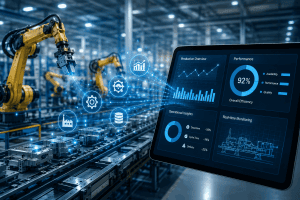
With DataLens, you gain near real-time visibility into shop-floor KPIs such as cycle time, throughput, OEE, and downtime by ingesting data from OT, MES, and IT systems. DataLens breaks down availability, performance, and quality losses automatically, helping teams identify issues caused by equipment failure, defects, or speed losses. It also flags deviations from historical baselines, enabling supervisors to act before small issues impact output or delivery.
Get clear performance summaries, trend explanations, and a consistent view of production health with DataLens
5.2 Quality & Defect Analysis
DataLens consolidates data from inspection systems, MES, SPC tools, and ERP to provide a unified view of defect types, rates, and trends across lines, shifts, and products. These parameters are tracked and visualized in dashboards. Using its multi-agentic AI framework, DataLens identifies unusual spikes, dips, and patterns, even when values remain within traditional control limits. It converts complex quality data into natural-language insights and recommendations for quality engineers and production supervisors.
5.3 Supply Chain Optimization
DataLens compiles ERP, logistics, inventory, and production data to provide a unified view of supply, demand, order status, and inventory levels. It flags mismatches between forecasts, actual demand, and production output, helping manufacturers react before shortages or excess inventory occur. It analyzes inventory turns, aging, and stockouts to highlight slow-moving or excess inventory and opportunities to reduce operational costs. It can also perform supplier performance analysis, continuous risk monitoring, and autonomous inventory management.
DataLens fundamentally automates analysis, ensures continuous monitoring, and generates actionable recommendations for optimized manufacturing operations.
How Manufacturers Benefit from DataLens?
We have already established that the manufacturing sector can greatly benefit from DataLens in many ways. Now, let’s explore the business impact of DataLens and how manufacturers can benefit from it.
- Faster decision-making: DataLens enables business owners and decision-makers to take data-backed decisions without delay. With DataLens’s near real-time dashboards, decision-makers gain full visibility into production, quality, and supply chain metrics. Its AI-powered automated data consolidation matrix eliminates delays that result from manual reporting. Trends and anomalies are detected instantly, bringing critical issues to attention immediately. DataLens empowers leaders to move from reactive decisions to proactive actions.
- Reduced reporting effort: DataLens significantly cuts down reporting effort by automating data preprocessing, establishing correlations, data analytics, reporting, and insight generation. It eliminates the need for manual spreadsheet updates and cross-department data requests. Prebuilt dashboards eliminate repetitive reporting tasks. DataLens also supports scheduled analysis of data, minimizing human effort. With DataLens, teams can spend less time preparing reports and more time analyzing insights.
- Improved operational efficiency: In manufacturing and supply chain industries, delays can cause significant reputational damage and monetary loss. DataLens overcomes this by continuously monitoring KPIs like OEE, throughput, and downtime to identify bottlenecks. By identifying inefficiencies and anomalies faster, unplanned downtime can be reduced. Streamlining workflows allows teams to optimize resource utilization, thereby improving efficiency and profit.
- Better collaboration between teams: DataLens gives teams a unified view of KPIs and performance with proper context, serving as a single source of truth. Cross-team collaboration improves as insights are based on the same datasets. This breaks down data silos, encouraging proactive cross-team problem-solving.
From Reporting to Intelligence: The Way Forward
Manual reporting is tedious, expensive, time-consuming, labor-intensive, and most importantly, impossible to scale. Manufacturing requires real-time, contextually aware solutions that can keep up with the industry’s pace. DataLens effectively bridges this gap by moving organizations from reactive decision-making and analysis to proactive actions and adaptive processes. It is high time that manufacturers move ahead with this momentum rather than staying with outdated legacy systems and manual reporting. DataLens is giving that opportunity to manufacturers.