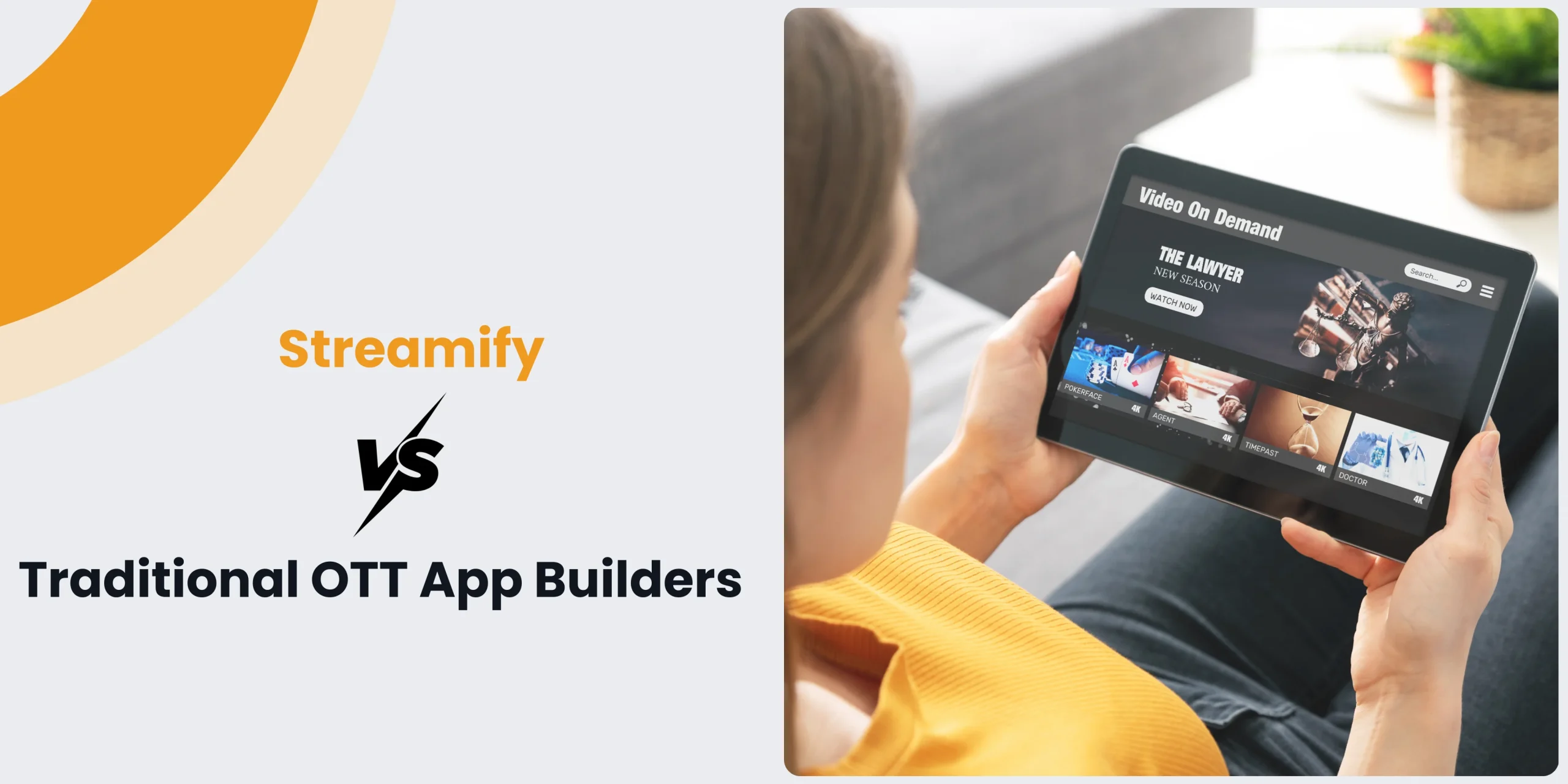
There is an overwhelming demand for OTT applications and streaming services in the United States at the moment. Most of it is attributed to the convenience and flexibility that on-demand streaming provides. From live sports events like the Super Bowl to coveted series premieres, OTT platforms have found their number 1 audience demographic in the US. In 2026, the United States OTT market size reached an impressive peak of 136.67 billion US dollars. And its steady projection is predicted to climb up to 234.73 billion US dollars by 2031, advancing at an 11.42% CAGR. With the smart TV penetration being marked at 88% of U.S. households, it is clear that this interest is not going to die down any time soon. Through this blog, we will explore one of the best OTT app builder comparison with traditional OTT app builders. Whether you are a startup launching a streaming service or an enterprise modernizing your digital media ecosystem, this guide will help you understand the key differences, strengths, and limitations to make an informed decision. We will look into Streamify, and its numerous features in contrast to other OTT app builders.
Understanding OTT App Development Platforms
An Over-The-Top (OTT) app builder is a no-code or low-code OTT streaming platform built to seamlessly deliver content for businesses, individuals, content creators, and enterprises. These platforms help anyone, regardless of background or experience level, create, customize, brand, and deploy OTT streaming applications for video-on-demand (VOD), live streaming, or hybrid content delivery with multi-device support.
These platforms typically offer tools for:
- Content management and delivery
- User experience and personalization
- Monetization and billing
- Analytics and reporting
- Security and compliance
- Integrations and automation
Benefits of OTT App Builders
- Speed: Launching a fully customized OTT platform is possible within weeks, as opposed to the months required for a custom build.
- Cost efficiency: Using an OTT app builder is more economical as it eliminates the need for a large development team.
- Zero expertise required: These platforms are often no-code or low-code and white-labeled, with drag-and-drop interfaces, pre-built templates, and modular components.
- Scalability: Platforms built for cloud compatibility or native to the cloud can be scaled effortlessly.
Traditional OTT builders were designed when streaming ecosystems were far simpler. Most traditional OTT platforms rely on rigid architectures and manual workflows, whereas modern platforms like Streamify are built to support high traffic, real-time analytics, AI-driven personalization, and multi-platform distribution.
What are Traditional OTT App Builders?
As discussed earlier, traditional OTT app builders originated from a time when the video streaming ecosystem and viewer expectations were minimal. They usually require manual coding and integration and follow conventional development frameworks. They offer robust backend infrastructure for video-on-demand and live streaming, support multi-device apps, and provide monetization through agencies or enterprise vendors. However, they still offer limited scalability and require technical expertise for maintenance. This prevents them from meeting the evolving requirements of modern audiences and OTT solution providers.
These OTT platform builders typically require at least three months of development and a fully equipped development team. They also need manual maintenance to ensure smooth operation. These solutions commonly have the following bottlenecks:
- Monolithic system architecture
- Separate vendors for CMS, billing, analytics, and DRM
- Heavy reliance on in-house engineering teams
- Manual maintenance and updates
- Limited automation and intelligence
While they support customization, they often struggle to scale efficiently in today’s high-demand streaming environment.
What Is Streamify?
Streamify is a next-generation intelligent OTT platform builder that supports the expanding needs of modern audiences and OTT service providers. Built on a cloud-native architecture, it is designed for scalability, intelligence, and speed. Streamify enables individuals, media houses, and enterprises to launch and manage their own OTT platforms with minimal engineering overhead.
Streamify enables easy launch, management, and scaling of OTT platforms. It offers a comprehensive OTT platform and thereby eliminates the need to build systems from scratch. It also comes with a versatile set of subscription models.
Streamify’s all-in-one streaming ecosystem includes a centralized admin portal and ready-to-deploy mobile applications. Built on AWS-based cloud-native infrastructure, Streamify ensures scalability, reliability, and security. It features a built-in intelligent AI system that personalizes user experiences through a strong recommendation engine. It also supports advanced analytics for user engagement, cast and crew management, and more.
Key Characteristics of Streamify:
- Cloud-native infrastructure
- Modular and extensible design
- Built-in AI and analytics
- Automated workflows
- Multi-device compatibility
- Integrated monetization tools
Streamify reduces time to market while ensuring operational efficiency, optimized cost efficiency, and reduced technical dependency.
Streamify vs Top Traditional OTT App Builders in the USA
Now that we have explored both traditional OTT builders and Streamify, let us compare their features.
|
Feature Category |
Streamify |
Traditional OTT App Builders |
| Architecture | Cloud-native, microservices-based architecture enabling independent scaling and high availability | Mostly monolithic architecture with tightly coupled components |
| Content Management System (CMS) | Advanced built-in CMS for managing videos, metadata, thumbnails, subtitles, and assets | Relies on third-party or custom-built CMS solutions |
| Multi-Device Support | Native support for iOS, Android, web, tablets, smart TVs, and streaming devices | Often requires separate development efforts for each platform |
| Personalization & Recommendations | AI-driven content recommendations and personalized dashboards | Limited or manual personalization capabilities |
| Monetization Models | Supports SVOD, AVOD, TVOD, hybrid models, in-app purchases, and pay-per-view | Requires custom integrations for monetization |
| Ad Management | Built-in ad insertion, targeting, and reporting tools | Depends on third-party ad platforms |
| Analytics & Reporting | Real-time dashboards, user behavior tracking, and predictive analytics | Basic reporting with limited insights |
| Scalability | Automatic scaling to handle traffic spikes and growing user bases | Manual scaling with infrastructure constraints |
| Live Streaming Support | Low-latency live streaming with global CDN integration | Requires complex custom setup |
| Global Content Delivery | Integrated multi-CDN support for optimized global streaming | Limited or external CDN integrations |
| Security & DRM | Built-in DRM, encryption, secure authentication, and geo-restrictions | Security features implemented separately |
| Compliance | GDPR, CCPA, and regional compliance built into the platform | Compliance handled manually |
| Developer Tools | Comprehensive APIs, SDKs, CI/CD pipelines, and documentation | Limited tooling and fragmented documentation |
| Third-Party Integrations | Seamless integration with payment gateways, CRMs, ad networks, and analytics tools | Custom integrations required |
| AI & Automation | Automated tagging, recommendations, churn prediction, and quality monitoring | Minimal or no AI capabilities |
| Time-to-Market | Faster launches with pre-built modules and automation | Longer development cycles |
| Maintenance & Upgrades | Automated updates and minimal downtime | Manual updates and frequent downtime |
| Cost Efficiency | Lower long-term operational and maintenance costs | Higher development and maintenance expenses |
| Customization | Modular customization with scalable components | Deep customization through extensive coding |
| Future Readiness | Designed for continuous innovation and evolving OTT trends | Limited adaptability to new technologies |
What to Consider Before Making the Decision?
Choosing the right OTT app development platform is a strategic decision that impacts long-term growth, user engagement, and profitability. Before selecting an OTT app builder, clearly defining business objectives is essential. Platforms must be evaluated to determine whether they meet specific needs such as growth, audience expansion, and premium content delivery. The right OTT app builder aligns with long-term business vision.
Business Goals
Clearly defining short-term and long-term objectives and identifying target audiences helps in selecting the right OTT app builder. Aligning platform capabilities with growth plans is critical. If rapid expansion and faster market entry are goals, traditional OTT builders may not be the correct choice. Evaluating personalization, engagement support, and future expansion capabilities is also important.
Budget Constraints
Budget constraints should be considered before committing to a platform. Ongoing infrastructure and maintenance costs, along with initial setup expenses, determine long-term operational costs. Pricing transparency and hidden fees should be reviewed. ROI must be evaluated before investment. Cost should be compared with expected performance and reliability.
Scalability Needs
If audience growth is a priority, choosing a platform that supports traffic spikes and content expansion is critical. Evaluating auto-scaling and load management ensures performance stability. Global delivery capabilities should also be assessed.
Technical Expertise
Assessing internal technical skills against platform complexity helps determine maintenance requirements. No-code, low-code, or managed service options can reduce dependency on external vendors.
Monetization Strategy
The OTT app builder should support preferred revenue models, including subscriptions and advertising. Pay-per-view and in-app purchase capabilities must also be verified.
Business Impact of Making the Right Choice
The OTT industry is evolving rapidly with changing consumer behavior, technology, and competition. In a hyper-competitive market, outdated development approaches are time-consuming and uneconomical. Modern streaming ecosystems demand scalable OTT solutions that embrace innovations such as AI integration. With legacy systems limiting scalability, there is a clear shift toward intelligent and automated platforms.
From a business perspective, modern OTT platforms like Streamify reduce time-to-market and eliminate the need for full-cycle development teams, improving profitability. AI integration enables hyper-personalized user experiences, while cloud-native architecture ensures scalability. Smart analytics support viewer behavior analysis and ad optimization. Flexible monetization models further enhance revenue potential. Where traditional builders lack speed and efficiency, Streamify delivers profitability, better user experience, customization, and long-term sustainability.
If you’re evaluating OTT infrastructure for 2026 and beyond, it may be time to explore a platform built for scale and intelligence.