Video is no longer an emerging trend in business communication. The HubSpot report indicates 85% of businesses use video for marketing and 87% for internal and external communication. This shift has been further intensified, with the World Economic Forum observing that digital video usage increased by nearly 10 times since 2020. What once supported marketing alone now fuels training, onboarding, knowledge management, and collaboration across enterprises. The way information is shared, the cognitive psychology behind it, and its retention have changed as businesses are now turned towards a video-first methodology. Aragon Research data indicates that visual content is processed 60,000 times faster than text, and almost 8 out of 10 viewers remember what they have seen. This makes video a great medium for how we learn and communicate, equipping organizations to increase their adoption across teams and geographic locations. At the same time, along with the growth comes complexity, which traditional tools are often unable to cope with.
Video content usually becomes fragmented, hard to secure, and cumbersome to scale into enterprise systems. So, this leads to a fundamental question: how do businesses handle video properly and securely at scale? The answer lies with Enterprise Video Platform (EVP), a unified solution designed to streamline, secure, and simplify video communication across the entire organization.
What Is an Enterprise Video Platform?
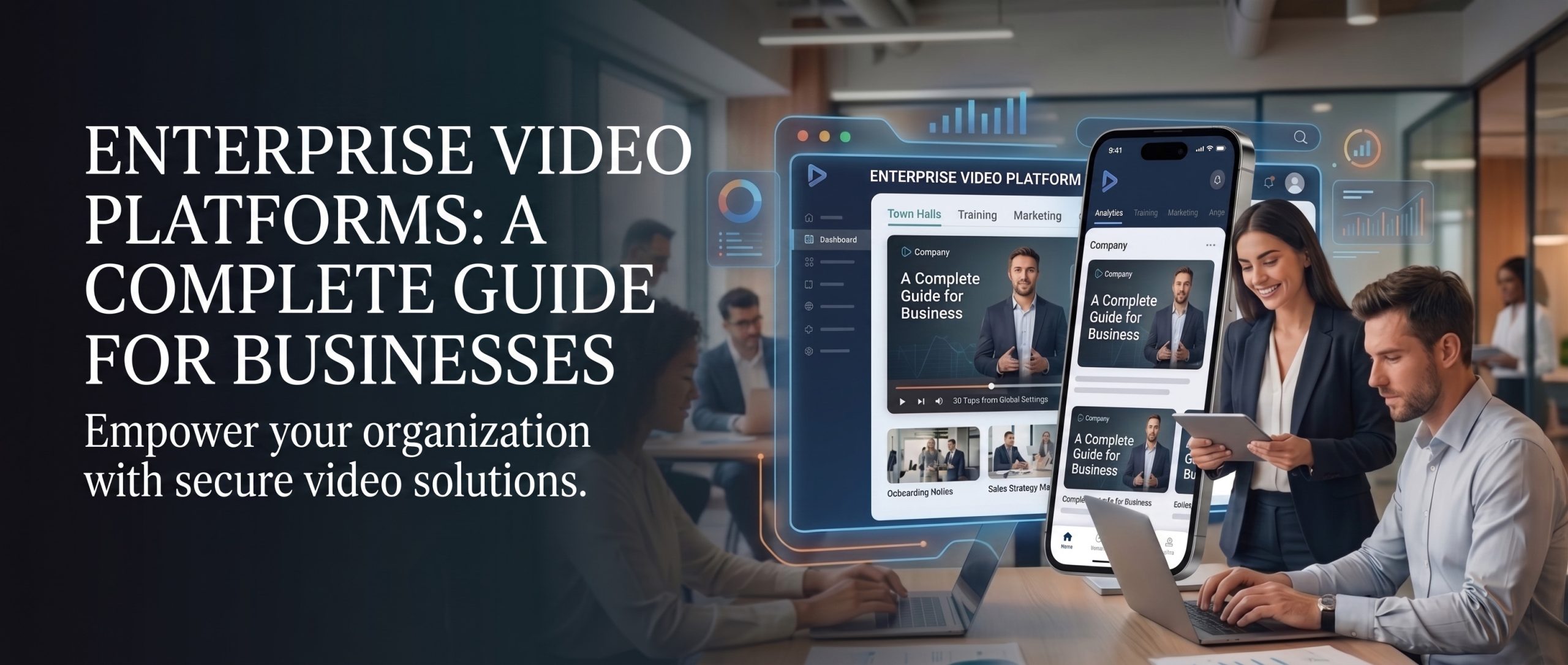
An Enterprise Video Platform (EVP) is more than just a location to store and stream videos. It gives companies a central hub to create, manage, organize, and share their video content — all in one spot. Think about employee training, daily communication, big team meetings, or marketing campaigns. An EVP keeps everything structured, whether it’s used inside the company or sent out to customers and partners. Cisco Systems’s Visual Networking Index (VNI) states that video makes up almost 90% of all internet traffic. So, businesses aren’t just making videos — they depend on them to run smoothly. Regular platforms like YouTube or Netflix are built for public content, and tools like Zoom or Teams work well for meetings and calls. An EVP is different. It’s designed for businesses, with a real focus on security, scaling up as companies grow, and connecting with other systems.
Key Features of an Enterprise Video Platform
1. Video Content Management
The backbone of any EVP is its content management system. This is where all your videos are organized, tagged, indexed, and made searchable. It sounds basic, but when you’re dealing with thousands of files, it’s crucial. If you don’t have good metadata or smart categorization, your video library quickly turns into a mess. An EVP keeps things tidy and structured, so employees can find the right clip fast
2. Live Streaming & Webcasting
Real-time communication is pretty much the norm now. Town halls, product launches, webinars, trainings — all happening live, often with teams spread out around the world. As video usage keeps exploding, your platform needs to handle high-quality, low-latency streaming, no matter the audience size. EVPs do this well, offering smooth live and on-demand video without the usual tech headaches.
3. Security & Compliance
This is where enterprise requirements get serious. Video content usually carries sensitive info—company secrets, internal updates, customer data. So, you need strong security features like encryption, tight access controls, and compliance measures. Honestly, security isn’t just a box to check—43% of organizations say it’s one of their top concerns when adopting enterprise video (Global Growth Insights). EVPs address this head-on with enterprise-grade protection.
4. Analytics and Insights
An EVP is more than just a place to host content; it also tells you how well it works. Who watched a video, how long they stayed, and where they left off. These insights are very helpful. Many platforms now use AI to do even more in-depth analysis, like transcription, keyword extraction, and even sentiment analysis to figure out how people feel about something. This makes the video a measurable, data-driven asset instead of just a one-way broadcast.
5. Integrations
Nobody wants another siloed tool. EVPs connect with your CRM, LMS, HR systems—all the usual suspects—so your videos fit right into daily workflows. Industry research shows that over 60% of enterprise platforms now offer integrations with core business tools. Video isn’t floating on its own anymore—it’s part of your digital ecosystem, seamlessly blending right in.
Key Use Cases Across Business Functions
1. Employee Training & Onboarding
Enterprise video really changes the game for training positively. Instead of running the same session over and over or handing out boring paperwork, companies set up video libraries that people can tap into anytime. It’s perfect for onboarding new employees or helping current staff learn new skills. Global Growth Insights says 38% of all corporate videos are for training, proving how essential video has become in learning and development. It’s faster, more consistent, and far more engaging.
2. Internal Communication
Emails can feel cold or get lost in your inbox, but a quick video from leadership or for company news just hits differently. It makes things clearer and gives messages a more personal feel—especially when teams are spread out or working from home. And if you missed something, you can just replay the video and stay in the loop without having to set up another meeting.
3. Marketing & Sales
Now, this is where video really stands out. Think product demos, customer stories, or fun explainers—they all build trust and sway decisions. People notice the difference. According to SundaySky, 87% of marketers see more visitors on their sites thanks to video. It’s not just about telling stories; video directly boosts engagement and sales.
4. Customer Support & Education
Support teams these days are leaning into video tutorials and walkthroughs instead of those endless help articles. People get to see exactly what to do, step by step, which makes everything clearer and speeds things up. Customers find answers more quickly, and their experience improves. Also, the same videos work great for onboarding new employees to the company.
5. Events & Webinars
Live and on-demand events are still a big deal. Companies use EVPs to run town halls, big conferences—really, any kind of event—and they can easily record and reuse that content later. As more events go virtual or hybrid, these video platforms make sure everything stays easy to access, long after the live broadcast wraps up.
Benefits of an Enterprise Video Platform
1. Centralized Video Management
Everything finally has a place to be. No more hunting through drives, emails, or random cloud folders—videos all live in one place. They’re tagged, easy to search, and right there when you need them. What used to eat up minutes or even hours now happens in seconds.
2. Video Analytics and Insights
Video shouldn’t feel like guesswork. With the right platform, you start to notice patterns—who’s watching, when people tune out, what really grabs attention. These insights don’t just churn out more content; they make each video better, sharper, and more relevant.
3. Content Security
Some videos just aren’t for everyone—internal plans, training sessions, customer information. They need real protection. EVPs lock things down with layered security, access controls, and encryption, so your content stays right where it belongs.
4. Improved Communication
Enterprise Video brings in tone, makes things personal, and adds a human touch. Leadership updates feel genuine, and training sessions make sense. No matter the location or time zone, messages come through clearer and a whole lot more effective.
How to Choose the Right Enterprise Video Platform?
Picking an EVP means looking past checklists. What matters is whether it stays strong as demands on video increase, which they always do.
1. Core Infrastructure and Scalability
You need to start with the building blocks. What kind of hosting, encoding, and delivery can the EVP offer, and does it come with a scalable CDN? Since video is increasingly king on the internet (Cisco predicts it will make up 90% of all traffic), a high-performing platform is non-negotiable. Even small lags can hurt user experience and engagement in the enterprise space.
2. Security Designed Into the System
Don’t let security be an afterthought. Often, enterprise video content includes sensitive internal communications or proprietary data. You need encryption, role-based access, DRM, and the ability to restrict where the video can be viewed. In fact, 43% of organizations cite security as a primary concern (Global Growth Insights), so this is an important one to tick off the list.
3. Content Management and Analytics
A good EVP should make it easy to find and manage your video content. Look for a structured approach that includes tagging, metadata, and intuitive search features. Equally important are robust built-in analytics that provide clear insights into viewer engagement, performance metrics, and overall content behavior, so you’re basing your decisions on data, not guesswork.
4. Seamless Integration and Flexibility
How well does the platform play with your existing systems? Whether that’s your CRM, LMS, or internal applications, integration is key to a smooth workflow. 38% of businesses report struggling with integration challenges (Global Growth Insights), which is why choosing a flexible, API-ready solution is critical to your long-term success.
In the end, the best EVP is one that can meet your current demands while allowing you to grow – seamlessly and effectively
What’s the Future for Enterprise Video Platforms?
The enterprise video world is quietly shifting – but the change is noticeable. AI powers everything from automated transcriptions to analytics that go beyond view counts and focus instead on true engagement. Video content is becoming much more personalized. Companies are moving away from the one-size-fits-all model and toward personalized experiences for different groups of people, roles, or stages in the customer journey.
Approximately 62% of all video views are short-form, according to Visionary Marketing statistics, mainly on mobile. Combine that with the growing popularity of interactive video and the ever-present influence of hybrid work, and you can see where we’re headed. Video isn’t just a supporting tool for communications anymore – it’s actively influencing how businesses connect, learn, and even run.
Wrapping Up
Enterprise video is no longer just a supporting role. It’s now at the heart of how companies connect, train, and empower. As its significance continues to grow, so does the responsibility to govern video with purpose. When supported by the right technology, it evolves into a centralized, quantifiable, and scalable system. That’s where smart EVP solutions like LUMA from Travancore Analytics come into play. Designed to make things easier to understand, it gives businesses the power to bring all their video content together into one seamless experience. It’s not just about setting video out there; it’s also about making it work smoothly, smartly, and on a large scale.